
Home Visit Physiotherapy in Newcastle
Get in touch today
If you have any questions or to see how we can help
Physiotherapy at home in Newcastle and the surrounding villages
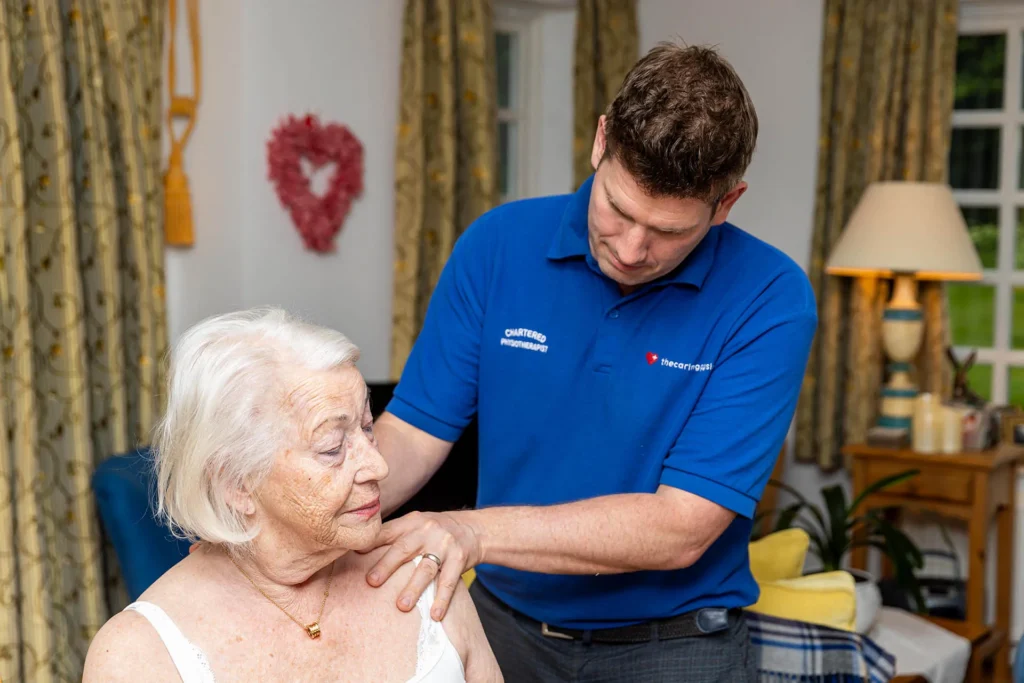
We provide home-visit physiotherapy across Newcastle, so rehabilitation happens where it actually has to work — your own stairs, your own bathroom, the step up to your own front door. Our chartered physiotherapists come to you at home or in your care home. There is no clinic to travel to, no waiting list to join and no GP referral needed.
Parts of Newcastle are steep, and the terraces climb away from the river at Byker and Ouseburn — but geography is not really why we come to you. Recovery is measured in what you can do yourself: your own stairs, the step out to the garden, the walk to the shops in Gosforth, getting into a car to see a friend. After an illness, or a spell at the Royal Victoria Infirmary, it is rarely only strength that has gone. Confidence goes with it, and both return fastest at home.
Our services in Newcastle include:
- Older people’s physiotherapy — falls, balance and confidence at home.
- Dementia physiotherapy at home or in a care home.
- Post-operative rehabilitation after a hip or knee replacement, whether at the Freeman Hospital or privately at Nuffield Health Newcastle Hospital.
- Neurological physiotherapy for stroke, MS or Parkinson’s.
- Respiratory physiotherapy for breathlessness and COPD.
- Muscle and joint pain relief for arthritis, back pain and post-fracture stiffness.
- Regular Care home physiotherapy across Newcastle and the villages.
- Rehabilitation for Rehabilitation for case management clients, including complex post-surgical cases.
Why families in Newcastle come to us
- Chartered physiotherapists, HCPC registered and CSP members.
- Visits at home or in a care home — no clinic travel.
- No waiting list of our own and no GP referral needed. If you are already waiting for NHS physiotherapy, we can start in the meantime and work alongside it.
- Time to do the job properly, not fifteen-minute appointments.
- Close communication with families, carers and GPs.
- The same physiotherapist wherever we can, so progress carries forward.
Most of the people we see in Newcastle are in their eighties, living in a house they have been in for decades, and what has changed is small and specific. Getting out to the back garden has become a two-person job. The walk to the shops at Kingston Park or the Grainger Market has quietly stopped, and with it the reason to go out at all. Families ring us after a fall or a hospital stay, when the ward routine has become too familiar and adapting to normal life again at home is the harder problem.
Every course of treatment begins with a full initial assessment in your own home, so the plan is built around your stairs, your bathroom and what you actually want to get back to. If you would like to talk it through first, we are happy to have a conversation before anyone commits to anything.
Areas we cover in and around Newcastle
Central and east Newcastle
- Newcastle city centre
- Jesmond
- Sandyford
- Heaton
- Byker
- Ouseburn
- Walker
- Walkergate
Gosforth and the north
- Gosforth
- South Gosforth
- Fawdon
- Kingston Park
- Newcastle Great Park
- Kenton
- Hazlerigg
- Brunswick Village
- Dinnington
The west end and the Tyne villages
- Fenham
- Benwell
- Elswick
- Westerhope
- Denton Burn
- Newburn
- Throckley
- Black Callerton
That covers most of NE1 to NE7, NE13 and NE15. Newcastle and the villages on its northern edge are looked after by our Tyne and Wear team. If you are just outside these areas — towards Gateshead, Whitley Bay or Wallsend — call us anyway and we will tell you honestly whether we can reach you.
We also visit families in nearby Blyth and Morpeth. See all the areas we cover.
The things people actually want back after returning home from hospital
A hospital bed is the right place to be while you need one, and the Royal Victoria Infirmary does that part well. What no ward can rehearse is your own house. After a stroke, a fractured hip or a bad infection, most of the ground is regained in the weeks after you get home — and it is regained on the specific things that have quietly been taken away.
- Washing and dressing yourself in the morning, in your own time.
- Managing a shower or a bath again, rather than a strip wash at the sink.
- Taking the bin out to the kerb on the right morning.
- Getting out to the garden and doing something in it, rather than looking at it.
- Going back to whatever made the week worth having — the allotment, the club, the choir, or the match.
- Not being stuck in the same chair from breakfast to teatime, which is how a week stops having any shape to it.
None of these are small things. Each one changes how much help someone needs through the day, and we work alongside carers and family so the gains hold between our visits. As independence comes back the care package often gets smaller — fewer calls, or one carer where there were two. In a city where families are often spread from Gosforth to the coast, being able to get into a car and go and see them is frequently the goal that matters most.
The Great North Trauma and Emergency Centre can save your life. It cannot get you back out to the garden.
Newcastle has two major hospitals and no community hospital in between. Emergencies and major trauma go to the Royal Victoria Infirmary, whose emergency department sees around 138,000 patients a year and which houses the Great North Trauma and Emergency Centre. Planned joint replacement, heart and chest surgery and transplantation are done at the Freeman Hospital, alongside the Northern Centre for Cancer Care. What the city does not have is a step-down hospital between those wards and your own front door — people go home directly, often within days, and the practising starts there.
This is the gap we close. We can usually be at the door within a few days of discharge, while there is still strength and confidence to build on. Call us as soon as you have a date.
Patients can spend 83% of a hospital stay in bed, and lose up to 5% of muscle strength a day.
Those are Newcastle Hospitals’ own figures, from their Make Movement Count campaign, which also puts ten days in hospital at the equivalent of ten years of physical ageing. The strength lost while waiting is strength that has to be won back afterwards — at home, and usually more slowly than it went.
How we close the gap
As soon as you have a date
Ring us with the discharge date and we book the first visit around it.
The right exercises, done with you
Not a sheet of diagrams left on the table. We do them with you, correct them as you go, and change them as you improve.
Helped, not taken over
It is easy for anyone, with the kindest intentions, to do things for someone that they could still manage themselves. We work with families and carers so the help being given builds independence back rather than quietly replacing it.
For as long as it helps
We stay while the work is making a difference and say so plainly when it stops. What we are working to give back is strength, and with it some dignity.
What patients say about our Newcastle team
I had a great service from the Caring Physio when recovering from an ankle fracture and surgery. Michelle visited me at home when I was housebound and helped me regain confidence in moving around the house and eventually walking. She arrived on time, offered practical advice, encouragements and a program to follow every sessions. I recommend this company. Thank you for putting me back on my feet (literally)
— ankle fracture and surgery with Michelle M.
Our experience of The Caring Physio Home service is excellent. We received a quick response to our initial enquiry and also a supportive phone call to clarify our needs. Michelle is providing physio and advice to our elderly mam and it is proving to be invaluable in improving mobility, flexibility and confidence. Michelle is great, very professional and approachable, with a lovely manner and ability to put our mam at ease and to motivate. I cannot recommend enough. Thank you Michelle.
— D. and K., Newcastle · mobility and confidence with Michelle M.
We cannot praise The Caring Physio enough. Michelle was superb. She was the first to scrutinise how I was wrongly using my walking stick and to show me how to use it more effectively. Exercises to open up the upper body to help breathing and effective deep breathing techniques were demonstrated. Michelle observed carefully how I was using them and suggested ways of improving further. At all times, care was kind and appropriate to my abilities. We intend to use their services again when my wife has her knee replacement.
— walking and breathing with Michelle M.
The physiotherapist who will come to see you
When you ring us, the person who picks up is a physiotherapist. Michelle M. is one of our Home Physio Coordinators, alongside Christina O. — between them they take the first call, answer the questions families actually have, and match you to the physiotherapist who will visit. It means the first conversation is with an experienced voice who already understands the condition you are describing, rather than someone taking a message.
Michelle coordinates our home visits across Newcastle, and she trained here. Her physiotherapy degree is from Northumbria University, her orthopaedic training was on the elective and trauma team at the Freeman Hospital, and her community placements were with Newcastle’s own domiciliary, palliative care and hospital discharge teams. Nine years running a hospice physiotherapy and wellbeing service followed — falls and balance, breathlessness, fatigue, and training the staff working alongside her.
Before she was a physiotherapist she was a social worker, for thirteen years. This experience helps because a home visit is rarely only about the patient — it is about the concerned daughter who rang, the carer who comes at eight, and the stairs everyone is worried about.
Outside work she has run the Great North Run fifteen years in a row, and she is at St James’ Park for the home games. You can read more on Michelle’s profile.
Meet your Newcastle physio team
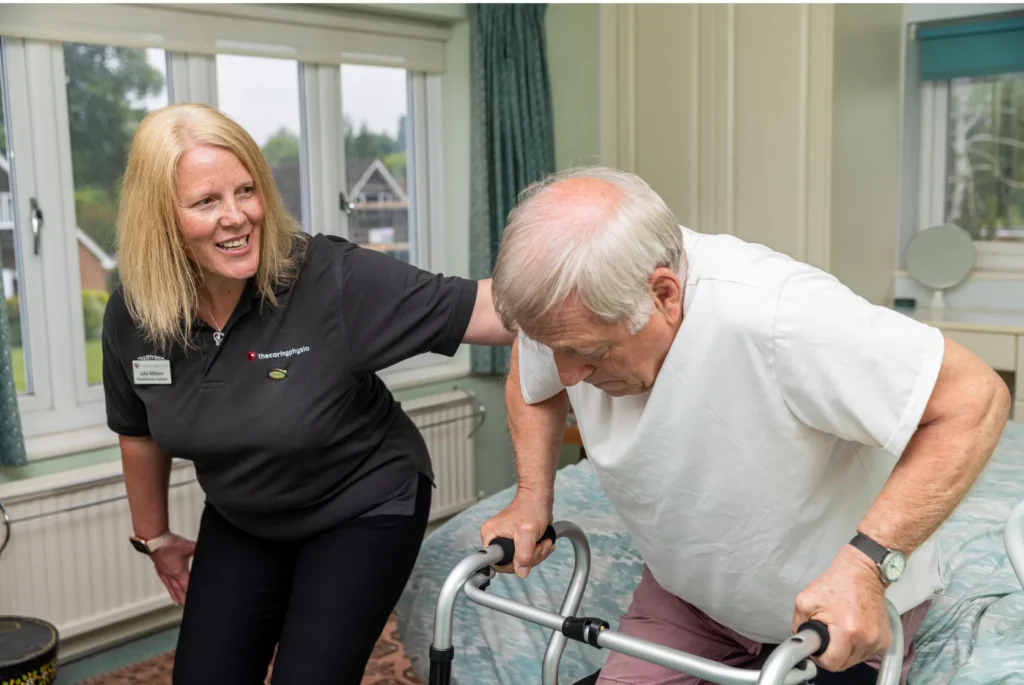
Pippa covers the north of the city: Gosforth, Jesmond, Kingston Park, Kenton, Fawdon and Great Park. She has worked in NHS frailty, stroke and neuroscience teams, and brings that experience to your own front room, building strength and confidence around the things you want to get back to.




Explore our physiotherapy services in Newcastle
FAQ - Your local questions
Can you help my relative come home from the Royal Victoria Infirmary?
Yes, and the sooner you call the better. Once a discharge date is set from the Royal Victoria Infirmary we can usually be at the door within a few days, while there is still strength and confidence to build on. With the ward’s agreement we can also assess before discharge, so the plan is ready on day one rather than a week later. Newcastle has no community hospital between the RVI and your own front door, which means the transition is abrupt — people who have come through the Great North Trauma and Emergency Centre often go straight home. That first fortnight is where most of the ground is regained.
My mother is in a lot of pain. I am worried that exercises and walking will hurt her or do damage.
We are gentle, and we start by working out what is actually causing the pain — because until that is addressed, no amount of exercise will help. Some soreness after movement she has not done for a while is normal, and Arthritis Action puts it plainly that moving a joint does not harm it. But that is not the same as pushing through pain, which we do not do. We work inside what she can genuinely tolerate and build from there, and if the pain itself is the barrier we say so and ask her GP to review it. Exercise is not the first step when someone hurts too much to move.
My father didn't engage with his last physio, how does your team help motivate people to do the exercises?
That is a fair worry and we hear it often. Physiotherapy only works if the person doing it wants to, so we start from what your father wants back rather than a standard programme — if that is getting to the shops rather than a set of exercises on a sheet, the shops are the goal. He sees the same physiotherapist wherever we can, so it becomes a relationship rather than a stranger every time. The first call is with Michelle M., a physiotherapist herself, who will listen to exactly this before anything is booked. And if the fit is wrong, say so — we will change who comes.
My Grandfather manages inside the house but has not been out since the winter. Can you help?
The longer someone has not been out, the more daunting it looks — that is normal, and it is not a reason to assume nothing can change. We do not write people off. If you have been told you will never manage something again, that was a judgement about how things stood at the time, and circumstances change. More often than not, a goal was missed because there was not enough time to build the strength and the confidence behind it, rather than because it was impossible. We will look at why, work on the actual route — the front steps in Heaton, the walk to the shops in Byker — and be honest with you either way.
I hear the first three months after a stroke are the most important. My father is past that now — can he still make progress?
You are right that the first three months are usually the most productive, but they are not a deadline. NICE’s stroke guideline is explicit that rehabilitation should continue for as long as it keeps helping someone reach their goals, and it asks for a review of needs at six months and then every year — which only makes sense if progress after six months is expected. Later gains tend to be slower and more specific: one transfer, one walk, getting back out around Gosforth rather than a wholesale recovery. If your father came out of the Royal Victoria Infirmary some time ago, it is still worth looking.
My husband's physiotherapy after his knee replacement at Nuffield Health Newcastle Hospital has finished. Can you carry on at home?
Yes, and this is a large part of what we do. A private package at Nuffield Health Newcastle Hospital, or an NHS one after surgery at the Freeman, usually ends while there is still real progress available — the knee bends further than it did, but the stairs, the car and the garden are not back yet. We pick it up at home, on your own steps rather than a gym’s. No new referral is needed and we can liaise with the surgical team where it helps.
My mother is worn out by the smallest effort. Would a physiotherapy visit be too much for her?
It should not be, because the visit is set at her level, not ours. For someone who tires quickly, a session might be ten minutes of work spread across the hour, with proper rests, done from her own chair. Doing too much sets people back; doing nothing lets strength drain away faster still, and finding the amount in between is most of the skill. We also look at why she is so tired, since pain, poor sleep, low mood or a medicine can all play a part, and with her permission we raise anything of that kind with her GP. If she is not well enough on the day, we say so and rearrange.
Local support in Newcastle
As well as physiotherapy, families often need to know what else is out there. These are local organisations we point people towards.
Elders Council of Newcastle — an older people’s forum for people who want a say in making Newcastle a good city to grow old in, working through peer research, focus groups and regular contact with decision-makers.
Age UK North Tyneside — runs the Admiral nurse dementia service that is open to people living in Newcastle or registered with a Newcastle GP, alongside information and advice, home care and social groups.
St Oswald’s Hospice — hospice care for adults, young people and children, based on Regent Avenue in Gosforth.
InformationNOW, Newcastle City Council — the route into a care needs assessment, equipment and care at home. Many families use council support and private physiotherapy side by side.
Care homes in Newcastle
Newcastle’s care homes range from large national groups to small independent homes, and both Newcastle City Council and InformationNOW publish directories with current CQC ratings. Wherever your relative lives, we can visit them there.
Most of this work is arranged and paid for privately by families — a block of visits after a fall or a hospital stay, or ongoing work to keep someone moving. It sits alongside whatever the home already provides, and we work with their staff so the exercises carry on between our visits. You can read more about additional physiotherapy for residents.
Care home managers in Newcastle — get in touch to discuss regular visiting physiotherapy for your residents.
Newcastle sits at the northern end of our Tyne and Wear coverage, alongside home visit physiotherapy in Sunderland and physiotherapy at home in Durham — and eight miles up the A696, home physiotherapy in Ponteland, where Emma also covers. Not sure if we reach you? See all the areas we cover.