

You went into hospital with one problem. A chest infection.
Seven weeks later you came home with four.
Before it, you walked down to the bottom of your garden. Now you need a frame to cross three metres of carpet.
Before it, nobody came into your house. Now two carers come four times a day to help you walk from the bed to a commode standing beside it.
Before it, you managed the stairs and slept in your own bedroom. Now your bed is in the dining room.
And you have a pressure sore, from seven weeks of sitting on a ward, which the district nurse dresses twice a week and which hurts every time.
The chest infection was treated. Everything else happened while it was being treated.
This is one of the most common situations we are called into as physiotherapists visiting older people at home, and families almost always describe it the same way: nothing went wrong, exactly, and yet the person who came home is not the person who went in.
Why it happens, and whose fault it isn’t
It is not neglect. It is not bad nursing. It is arithmetic. It happens the same way whether the package was arranged in Newcastle, Coventry or Guildford — the plan gets written on the worst day, and then nobody goes back to it.
In your own home you stand up perhaps forty or fifty times a day without noticing — off the sofa, out of bed, up from the lavatory, to answer the door, to fill the kettle. Every one of those is a squat under load. Nobody calls it exercise, but that is what it is, and it is the reason your legs still work.
On a hospital ward, most of that disappears. Meals arrive. Drinks arrive. The lavatory is a commode brought to you, or a nurse with a hoist. The floor is unfamiliar and there is a cannula in your arm and a rail on the bed, and the sensible, safe, kind thing everyone around you does is to bring things to you rather than let you get up and fetch them.
So the muscle goes. Not metaphorically — measurably. Skeletal muscle atrophies quickly with bed rest. Alongside it goes joint range, balance, and the thing that is hardest to measure and hardest to get back: confidence. We have written in more detail about how quickly strength disappears on a ward.
Seven weeks of that is a long time. And because the medical problem is the thing being treated and recorded, the losses that accumulate around it can be nobody’s job to notice.
The cotton wool problem
Then you come home, and something else starts happening — with the best intentions in the world.
Nobody wants to be the person who let an eighty-four-year-old fall over. Not the carer, not the daughter, not the physiotherapist. The guilt of that is genuinely awful, and everyone around the person feels it in advance. So we wrap people in cotton wool. We hold the arm that does not need holding. We fetch the cup. We do the buttons because it is quicker, and because watching someone struggle with buttons is uncomfortable.
Every one of those decisions is kind. Taken together over six weeks, they are the thing preventing recovery.
There is a principle in rehabilitation called positive risk-taking. It means accepting that a small, considered, supervised risk today buys a large gain in independence later — and that removing all risk removes all opportunity. A person who is never allowed to try standing will not get better at standing. There is no other route.
That does not mean being reckless. It means being deliberate about which risks are worth taking, with someone present who knows what they are looking at.
What we actually do in the house
People assume physiotherapy means exercises. Exercises are part of it, and they matter. But in this situation the bigger part of the job is something else: finding the independence that is hiding inside the care call. It is the same work in a terrace in Bath as in a bungalow outside Winchester.
A carer arrives to wash and dress someone. That visit takes twenty-five minutes and involves perhaps thirty separate small actions. Almost all of them are currently done to the person. Many of them could be done by the person, with time and encouragement.
Washing under their own arms. Putting their own trousers over their feet. Combing their own hair. Doing up one button on a shirt — then two.
None of that sounds like rehabilitation. All of it is. It is repeated, functional, daily, and it happens whether or not anyone feels like exercising. A person who does their own top half every morning is doing shoulder work four hundred times a year without a single set of repetitions.
The barrier is usually time. A carer has a schedule and the next call is at nine. Doing it for someone takes four minutes; letting them do it takes eleven. That is not laziness — it is the shape of the job.
So part of what we do is make the case, in writing, for where those eleven minutes are worth spending, and which tasks are the ones to hand back first.
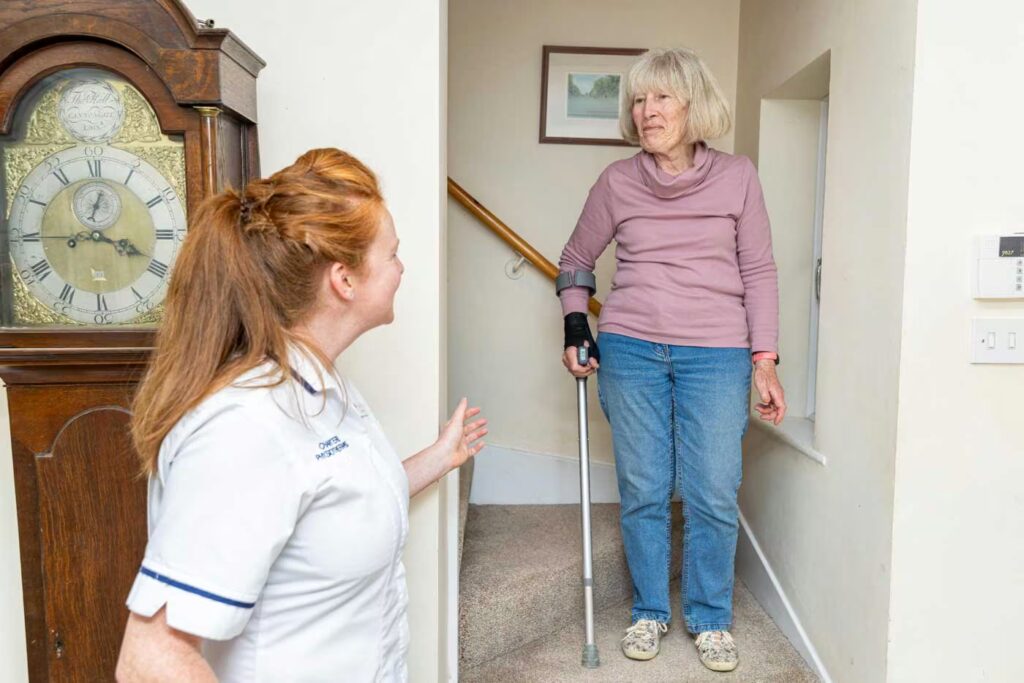
Working alongside carers, not around them
We are not there to tell a care team they are doing it wrong. In our experience they are doing exactly what they were asked to do, which is to keep someone safe and get through the visit.
What changes things is being specific. Not “encourage independence” — that is a phrase, not an instruction. Instead:
- Let her wash her own face and underarms. Sit her on the perching stool, put the flannel in her right hand, and wait.
- He can pull his trousers up from mid-thigh if you get them over his feet first. Give him thirty seconds before helping.
- She can walk to the bathroom with the frame and one person supervising. Two are no longer needed for this.
Written down, on the care plan, with a name against it. That is the difference between a suggestion and a change.
There is also a sequence to it. You do not go from two carers to one overnight. You go from doing to supervising — same number of people, same number of visits, different job while they are there. Only once someone has been steady on supervision for a couple of weeks does the number itself come down.
If two carers come, watch what the visit is like
Double-handed care exists for good reasons, and they are usually moving and handling ones — a hoist, a transfer that needs two people, an assessment that judged one person could not do it safely. That is a legitimate call and we would not second-guess it from the outside.
But two carers changes the visit itself, in ways that have nothing to do with whether both are needed.
With two people in the room, the person being cared for participates less. Not through anyone’s fault — it is simply faster and more natural for two pairs of hands to complete the task between them. The conversation tends to happen between the carers rather than with the person, who becomes the thing being worked on rather than someone in the room. And because two people can finish quickly, the visit often does.
A single carer has no choice but to involve the person. They cannot lift a leg and hold a sleeve at the same time, so they ask. They wait. And their attention is on one person for the whole visit, which is worth more than it sounds.
So it is worth watching a visit, or asking the carers what the second person is doing at each stage. If it is a specific handling task, that is the answer and it settles it. If it has become two people getting through the call together, that is worth raising at review — not to cut the care, but to ask whether one carer with more time would achieve more.
Someone has to make the case
A care package does not change because a family feels it should. It changes when a clinician documents what someone can now do, and asks for a review.
That means a written record of what has changed, a named goal that has actually been met, and a phone call to whoever holds the plan — the community occupational therapist, the social worker, the case manager. It is not complicated work. It is simply work that has to be done by someone, and in practice there is often nobody whose job it is.
We do it as a matter of course, because otherwise the improvement sits in the house and never reaches the paperwork. A person can be walking to the bathroom unaided for two months and still have four calls a day on the plan, because the plan reflects the day it was written and nothing since.
Advocating for someone is not an extra. For older people in particular it is often the difference between getting better and being recorded as having got better — and only the second one changes anything.
What a good outcome looks like
None of this happens automatically. There is no scheduled review that catches everyone. A care plan is written at the point of maximum need, and unless somebody flags it, it simply carries on — through the improvement, and past it. We have met people who had been on the same package for two years, having got steadily better throughout, because nobody was looking and nobody wanted to be the one to suggest less help.
So a good outcome is not a discharge summary. It is a phone call.
The physiotherapist rings the community occupational therapist, the family, or the care manager and says: she has been walking to the toilet with the frame unaided for three weeks now, day and night. The night call is no longer doing anything. I would suggest reviewing it.
Toileting is very often the hinge. It is the task that most determines how many visits a day someone needs, and it is the one that carries the most dignity. When someone can get to the lavatory on their own, a great deal else follows — including the pad going in the bin, which people rarely mention and almost always mind about a great deal.
From four calls a day to two is a common shape for this. Sometimes it is four to one. Sometimes it is two carers to one, which is its own enormous change in how a house feels.
The same applies in care homes, where a resident’s level of assistance is often set on admission and rarely revisited.
When it does not work, and we will tell you
This is not always the right expectation, and we would rather say so at the assessment than six weeks in.
Some conditions are progressive. In Parkinson’s, in motor neurone disease, in advancing dementia, the honest goal may be to slow a decline or to keep a specific ability for longer, not to reverse it. Neurological physiotherapy at home still has a great deal to offer in those situations — but the aim is different, and we will say so. Someone whose thinking is significantly affected may not be able to carry a new routine from one day to the next, however well they manage it while we are in the room.
And some people are simply where they are. Very advanced frailty, multiple long-term conditions, a heart that will not tolerate the work — these are real limits, and pushing against them helps nobody.
In those situations physiotherapy still has plenty to offer: comfort, positioning, keeping a transfer safe for the person doing it, preventing the next problem. But it is not this article’s argument, and we will say so plainly rather than let a family hope for something we cannot deliver.
One thing we would never suggest is that a family reduce someone’s care on their own. If you want to know who would actually come, and which hospital we usually pick people up from, the page for your own town will tell you.
Common questions
Can a care package be reduced once it has been set up?
Yes, and it often should be. A package is written on the day somebody comes home, which is usually their worst day. It is a snapshot of that moment, not a permanent judgement. If somebody gets stronger, the package should follow — but nobody automatically goes back and looks, so it usually stays exactly as it was written until a family asks.
Why does someone get weaker even with carers visiting several times a day?
Because good care can quietly remove the very activity that was keeping them going. Every stand, every walk to the kitchen, every reach into a cupboard that somebody else does is practice they have not had. Said plainly: if it is always done for her, she will not get stronger. Nobody is at fault — it is quicker, it is safer in the moment, and it feels kinder. Any of us would.
Should a family reduce someone’s care themselves?
No, and it is the one thing we would never suggest. Reducing a package is a decision for the people who assessed it, made with evidence in front of them. What a physiotherapist can do is provide that evidence — measured, written down, and showing what has actually changed — so that the review happens on facts rather than on an impression.
What does a good outcome look like when someone is on a care package?
Usually less help rather than more: fewer calls, or one carer where there were two, or a transfer that no longer needs a hoist. Sometimes it is that the package stays the same but the person does more inside it. And sometimes the honest answer is that the package is right and will stay right — in which case we will say so at the assessment rather than six weeks in.