
Home Visit Physiotherapy in Sunderland
Get in touch today
If you have any questions or to see how we can help
Professional and Caring Home Physiotherapy in Sunderland
At The Caring Physio, we provide home-visiting physiotherapy across Sunderland, shaped around your goals, routines, and living environment. Our clinicians come to you—whether that’s your own home or a care home—so effective treatment happens without the disruption of travelling to a clinic. Our Sunderland team are HCPC-registered, CSP-member physiotherapists with extensive experience in later-life mobility, post-surgery recovery, and long-term condition management—delivered with compassion, integrity, and enthusiasm. We focus on rebuilding strength, balance, and confidence after illness, operations, or a fall. Sessions target range of motion, muscle strength, balance and flexibility to rebuild confidence and function.
Our services in Sunderland include:
- Physiotherapy for older adults to enhance strength, steadiness, and daily mobility.
- Structured post-operative rehabilitation following hospital discharge.
- Neurological physiotherapy for Parkinson’s, stroke, and MS.
- Respiratory physiotherapy to support easier, more efficient breathing.
- Targeted treatment for joint and muscle pain.
- Specialist physiotherapy for care home residents.
- Bespoke, case-managed rehabilitation programmes.
Why families in Sunderland come to us
Sunderland blends maritime heritage and riverside industry with beaches at Roker and Seaburn, the sweep of the River Wear, and big matchdays at the Stadium of Light—great places to stay active close to home. From cliff-top promenades and coastal paths to Wearmouth Bridge approaches and everyday errands in the city centre, we help you move comfortably where it matters most. We visit homes throughout Sunderland and nearby communities, including Washington, Houghton-le-Spring, Seaburn, Fulwell, Roker, Ryhope, Whitburn, South Shields, Hebburn, and Hetton-le-Hole.
Why people in Sunderland choose us:
- Experienced home-visit physiotherapists delivering practical, evidence-based rehabilitation.
- Flexible appointment options designed around your routine.
- Professional treatment in your home or care home—no clinic journeys required.
- Joined-up support with GPs, consultants, and care teams.
- A values-led approach centred on compassion, integrity, and enjoyment.
Every plan begins with a thorough assessment and a programme tailored to your goals. Book your home physiotherapy visit in Sunderland or the surrounding area today, and start your recovery in the comfort of home.
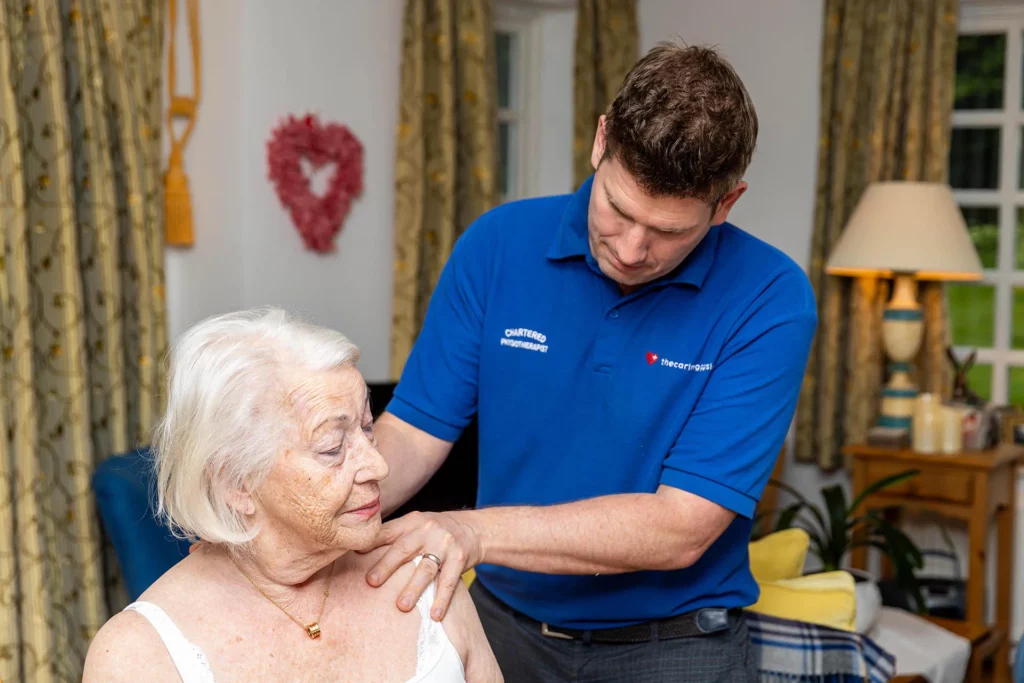


Helping you recover using physiotherapy in the comfort of your home
FAQ - Your local questions
Can you help my mother home from Sunderland Royal?
Yes, and it is worth ringing before she is discharged rather than after. The care of older people service at Sunderland Royal runs across six wards and covers acute elderly medicine, frailty, delirium and dementia care, so she will have had good work done on standing and moving. What a ward cannot rehearse is her own hallway, her own stairs and her own bathroom, and the first fortnight home is when most ground is lost. We take referrals straight from families, with no GP letter and no waiting list.
The community geriatric team have been involved. Do you overlap with them?
Not really, and we are glad when they are. Sunderland’s community geriatric service exists to respond quickly and, in the trust’s own words, to “avoid unnecessary attendance at the Emergency Department”. That is medical cover, and it is valuable. What tends not to follow is the slower work of building strength back up over weeks, which is what actually keeps somebody out of hospital the next time. That is our part, and with your permission we are happy to keep them and the GP informed.
Do you come out to the villages and the coast, or only into the city?
We come to you. Ashbrooke, Fulwell, Roker, Seaburn, East Herrington, Silksworth and Ryhope, and out to Whitburn, Cleadon, Washington, Houghton-le-Spring and Hetton. There is no clinic to get to and no car park to negotiate, which for a lot of our clients is the whole point — the journey to an appointment is often harder than the appointment.
She has stopped walking along the seafront. Nothing has happened. Is it too early to ring?
It is the right time, and it is the call we most wish families made sooner. Nothing dramatic has to happen for somebody to lose a lot of strength — they stop making the walk they always made, and the legs follow the habit down within months. By the time there is a fall there is usually a year of quiet decline behind it. We would work towards that walk itself — the front step, the road, the promenade, the bench she used to aim for — rather than exercises with no bearing on it.
She has carers in four times a day and she is still going backwards. I do not understand it.
It is one of the commonest things we are asked, and the answer is often not about muscle at all. Someone who has had a fall, or who has been helped for long enough, frequently stops trying before her legs stop working — and once she has stopped trying, the legs follow. Four calls a day can unintentionally confirm that she cannot manage, because every time she is about to try, somebody kind arrives and does it. We start by finding out which it is, strength or confidence, because they need very different work.
Do we need to go through the GP?
No. We are chartered physiotherapists and you can ring us directly. With her permission we will write to the practice if we find something that needs a doctor — pain that is not controlled, a medication affecting her balance, something we are not happy with — and we are glad to send progress reports if they want them. Nothing has to be arranged through the surgery before we can start.
She has dementia. Is physiotherapy still worth it?
Yes, and it is worth being specific about why. Dementia does not stop somebody getting physically stronger; it changes how the work has to be done — shorter sessions, the same order every time, instruction by demonstration rather than explanation, and practising real things in real places rather than abstract exercises. Sunderland Royal has put real effort into dementia care on its wards, and that thinking carries over to the house. Strength and balance protect independence and reduce falls whatever else is going on, and a fall is one of the quickest ways to lose the ground somebody has left.
Local support in Sunderland
As well as physiotherapy, families often need to know what else is out there. These are the organisations we are asked about most, and none of them charges for advice.
Sunderland City Council care assessments — where an assessment of care needs starts.
Age UK Sunderland — free local information and advice, on 0191 514 1131.
Sunderland Carers Centre — for anyone looking after somebody, on 0191 549 3768.
Care homes in Sunderland
Most of this work is arranged and paid for privately by families — a block of visits after a fall or a hospital stay, or ongoing work to keep someone moving. It sits alongside whatever the home already provides, and we work with their staff so the exercises carry on between our visits. You can read more about additional physiotherapy for residents.
Care home managers in Sunderland — get in touch to discuss regular visiting physiotherapy for your residents.