
Home Visit Physiotherapy in Ponteland
Get in touch today
If you have any questions or to see how we can help
Physiotherapy at home in Ponteland and the surrounding villages
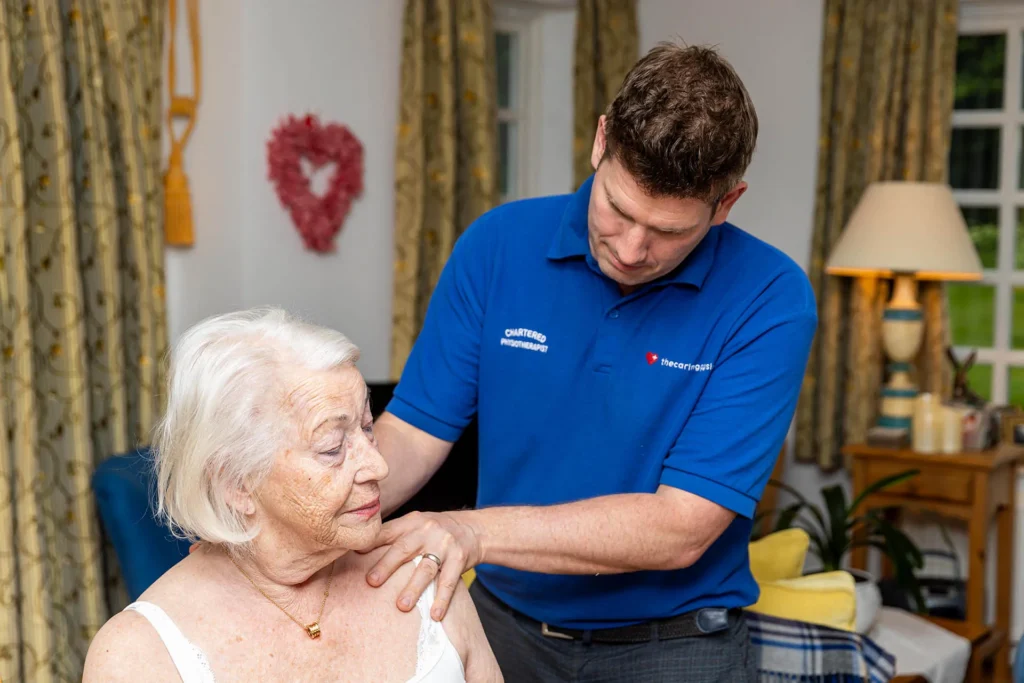
We provide home-visit physiotherapy across Ponteland, Darras Hall and the western villages, working on the stairs, chairs and doorsteps of the house you want to stay in. The physiotherapist who comes is chartered, and visits homes and care homes alike. There is no referral to arrange and no waiting list of ours to sit on.
Some families ring while their relative is still on the ward, wanting something in place before she comes home. Others ring from a respite bed, where a fortnight has become a month and nobody is quite saying the word permanent. The reasons are usually specific — a hip replacement that healed well but left her frightened of the stairs, Parkinson’s that has made the walk to the car a two-person job, a fall that quietly ended the driving. Out at Stamfordham, Matfen or Ogle the nearest anything is a drive, so a loss like that closes down a great deal at once. It is frustrating and it is frightening, and it is also the point where the care package starts growing and a hospital admission stops being unlikely. Earlier is better, every time.
Our services in Ponteland include:
- Older people’s physiotherapy — balance, strength and getting the fear of falling down to size.
- Dementia physiotherapy — routines that keep someone walking, with the family shown how to help day to day.
- Post-operative rehabilitation — after joint replacement at Wansbeck General Hospital or the Freeman in Newcastle, or privately at Nuffield Health Newcastle Hospital.
- Neurological physiotherapy — for Parkinson’s, MS and stroke, including keeping function for longer.
- Respiratory physiotherapy — breathlessness, COPD, and getting moving again after a chest infection.
- Muscle and joint pain — for arthritis, back pain and the stiffness left behind by a fracture.
- Care home physiotherapy — visiting residents in homes around Ponteland and Darras Hall.
- Rehabilitation for case management clients — complex rehabilitation, reported back to whoever is coordinating the case.
- Live-in rehabilitation care — a live-in carer to keep the daily exercises going between our visits.
Why families in Ponteland come to us
Ponteland and Darras Hall are full of people who have done well and stayed put — long drives, large gardens and a firm wish not to leave either. What we are usually rung about is not a diagnosis but a narrowing: the stairs have become a once-a-day event, or the walk round to a neighbour in Milbourne has quietly stopped happening. Out at Stamfordham, Matfen and Ogle the nearest anything is a drive, so a small loss of confidence closes down a great deal all at once.
- Chartered physiotherapists only, every one HCPC registered and a CSP member.
- Visits at home or in the care home, so nobody has to be driven anywhere first.
- The same physiotherapist wherever we can, with a familiar colleague covering when they are away.
- Working with older people is what we do all day, every day.
- We speak up for your relative: with the GP, the care agency and the family.
- When the visits stop making a difference, we will tell you.
The first visit is an assessment, but the part that matters most is the listening. Her medication and history reach us on a form beforehand, so the hour is hers. We want to understand what she actually wants back and what is stopping her — often confidence rather than strength, and sometimes something a professional said that has stuck. Then we agree two or three goals and get some treatment and a first set of exercises done. Not a hard session. Not an empty one either.
Ponteland, Darras Hall and the western villages: our patch
Ponteland and Darras Hall
- Ponteland
- Darras Hall
- Medburn
- Milbourne
- Kirkley
- Berwick Hill
- Prestwick
The western villages
- Stamfordham
- Belsay
- Matfen
- Ogle
- Higham Dykes
- Callerton
That covers most of NE20. Pippa and Emma cover these between them for our Northumberland team. Towards Prudhoe, Corbridge or Heddon-on-the-Wall? Ring us and we will be honest about whether we can visit regularly.
What Ponteland families tell us they miss
Nobody recovers in a hospital bed; they recover after it. The specialist emergency care hospital at Cramlington does the acute part well, and then you are home, where the stairs and the bathroom are the ones you have always had. The weeks that follow are where the real ground is won or lost, and it is won on small specific things rather than on anything general.
- Out of the armchair by the window unaided, and back into it without dropping.
- Getting to the loo in the night without having to wake anybody.
- Answering the front door before whoever it is gives up and goes back down the drive.
- A walk round to a neighbour’s in Darras Hall for coffee, instead of waiting to be visited.
- Being left on your own for an afternoon without the family ringing round to arrange cover.
- Less fear of falling — which NICE lists alongside pain and injury as a consequence of a fall, and which is often what stopped things in the first place.
These are not small ambitions. Each one shifts how much help a day actually takes, and because we work alongside the family and any carers, the progress holds between visits rather than resetting. As more comes back the care package tends to shrink: fewer calls, or one person where two were needed. In the western villages, where a care visit means a driver covering ten miles between calls, needing fewer of them changes the arithmetic as well as the week.
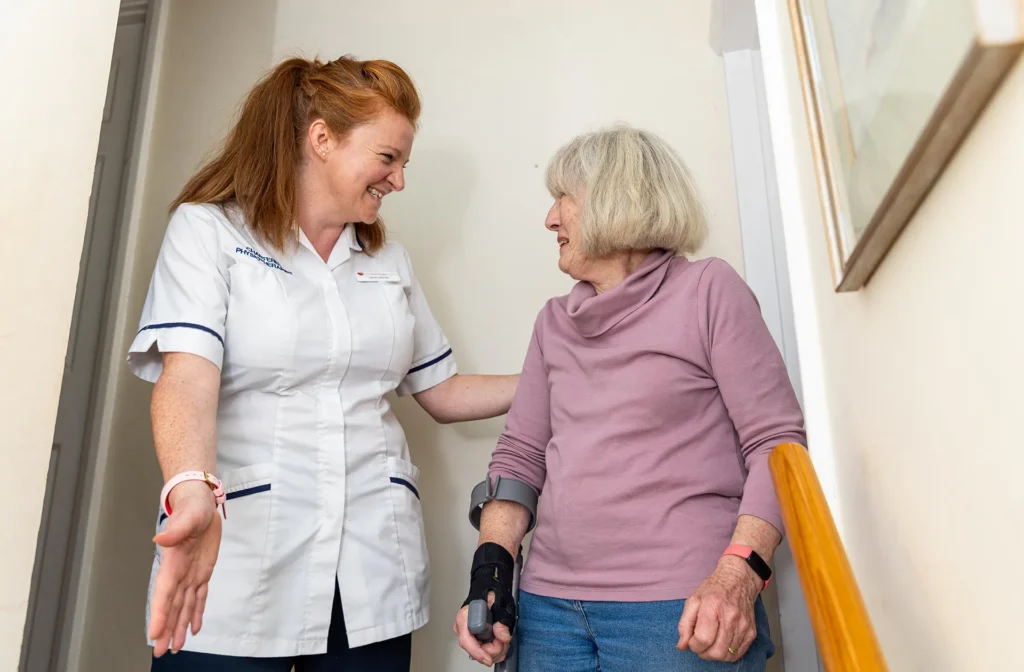
Cramlington can get you through the worst of it. It cannot get you back down your own drive.
The specialist emergency care hospital is at Cramlington, to the east of this patch — an emergency department, a critical care unit, CT, MRI, ultrasound and x-ray, seven specialty wards and high-risk planned surgery. There is also a Northumberland intermediate care unit on Lamb Street in Cramlington, run by the NHS within an independent care home rather than in a hospital of its own. What this corner of the county does not have is a community hospital. Newcastle is eight miles the other way, so for more complex care the Royal Victoria Infirmary and the Freeman are the realistic route — and then home, directly.
This is the stretch we cover. Ring us with a date and we are usually at the door within a few days — early enough that we are building on what is left rather than starting again from nothing.
Around 75, strength drains away at about 2.5–4% a year.
That figure comes from a review of how muscle changes with age, which also found strength goes two to five times faster than muscle size. The encouraging half: in a trial of frail people averaging 87, strength training more than doubled their muscle strength, against 3% in those who did not exercise. The loss is gradual and largely invisible until something interrupts it — a fall, an operation, a fortnight in bed — and then it is suddenly the whole problem.
How we close the gap
As soon as you have a date
Ring us with the discharge date and we book the first visit around it.
Pitched just right
Pitched to push you without knocking you back. Judging that balance, session by session, is the skill.
Standing again
We give you time to rebuild the strength and confidence to stand, and change the equipment as you need less of it.
While it is still helping
We keep coming while it helps, and tell you straight when it no longer does. The aim is strength, and the self-respect that comes back with it.
Meet your Ponteland physio team


Explore our physiotherapy services in Ponteland
FAQ - Your local questions
My mother is in hospital in Newcastle. Will you speak to the ward before she comes home to Ponteland?
Yes, with her agreement. People from Ponteland are often treated at Cramlington, or at the Royal Victoria Infirmary and the Freeman in Newcastle, and with no community hospital in between most come straight home. That makes the handover matter. We contact the discharge team, find out from the nurses and therapists what care, equipment or community physiotherapy has been set up, and book our first visit for her first days at home. If community physiotherapy has a wait, we cover the gap until it starts and then work alongside it.
My wife has dementia and forgets things within minutes. Can she still benefit from exercises?
Yes, in most cases — dementia changes how we teach, not whether physiotherapy works. We do not set a separate programme for her to remember. We hide the exercises inside her day: rising from the sofa, crossing the hall, the back doorstep, so routine does the remembering. The same physiotherapist comes wherever we can, which matters more than people expect — she is not meeting a stranger every week. And we show you what helps and what to leave alone, so it carries on between visits without becoming a battle.
Would we see the same physiotherapist each week, or whoever is free?
The same physiotherapist wherever we can, and we treat that as part of the treatment rather than a nicety. Progress carries forward when nobody has to start again from the beginning, and the small things — which chair she pushes up from, which step she is wary of — do not have to be explained twice. If your regular physiotherapist is away we will tell you rather than send a substitute unannounced. Pippa and Emma cover Ponteland, Darras Hall and the western villages between them, so if one is away the other already knows the area and can pick up your notes.
My father was told by a professional that he would not walk again. Is it worth another opinion?
Yes, a fresh assessment is reasonable. A professional’s view describes how things looked at that moment, and it may well have been right then; strength, health and circumstances change. Quite often what was missing was not ability but time to rebuild the strength and confidence walking depends on. We would see him at home, try the first steps of the progression with him, and tell you plainly what we think is achievable and what is not. You can then decide what to do, with no pressure from us either way.
How can I help Dad between sessions without getting it wrong?
Quite a lot — and the first thing is usually to do a little less of what you are doing already. It is easy for anyone, with the kindest intentions, to take over a transfer or fetch the cup rather than watch someone take four slow minutes over it, and that help, repeated daily, is how independence quietly goes. We will show you which bits to stand back for and which to hold on to. Beyond that: keep the walk to the kitchen happening, keep him out of the chair through the day, and tell us what you are seeing. You will not make things worse by asking.
Mum’s care home already runs an activities programme. Would physiotherapy add anything?
Most homes do a great deal of good work with movement, and what we add is different rather than better. A home’s therapy is usually about keeping everybody in the building safe and mobile; ours is one person, an hour at a time, working at a specific goal — standing from the chair unaided, getting to the dining room without the frame, coming off the hoist. We assess, set that goal and report back against it. We also show the home’s staff the rehabilitation inside what they are already doing, so it continues between our visits. It sits alongside their care, never in place of it.
My aunt in Darras Hall manages indoors but has hardly been out since the icy weather. Is it too early to call?
No, it is a sensible time to ring. When someone stops going out, it is often because the steps, the drive or getting into the car have started to feel risky, and the longer it lasts the more strength and confidence drain away. We would visit her at home in Darras Hall, see how she manages the front steps and the drive, and build a plan around one real outing, perhaps the walk to the shops on Broadway. She does not need a referral, and you can make the call for her. Small, regular practice now is far easier than rebuilding after a fall.
Local support in Ponteland
Physiotherapy sits alongside other local help. These are the organisations Ponteland families ask us about most.
Age UK Northumberland — the county charity for older people, offering information and advice, care at home, day centres and lunch clubs, befriending and advocacy from its base in Ashington.
Live Well with Dementia groups, Age UK Northumberland — no-cost groups for those living with mild to moderate dementia, held at Merton Hall on Merton Road, Ponteland, on Thursday mornings, and at Manor Walks in Cramlington on Monday afternoons.
Tynedale Hospice at Home — free home-based nursing, complementary therapy, patient transport and bereavement support for Tynedale, Ponteland and West Northumberland, for people registered with one of its listed GP practices including Ponteland Medical Group.
Onecall, Northumberland County Council adult social care — available day and night on 01670 536400 for care assessments, equipment and care at home. Council support and private physiotherapy can run at the same time.
Care homes in Ponteland
Homes around Ponteland run from large operators to small independent houses — Ponteland Manor on Thornhill Road among them. Ratings for any home are on the CQC register; the county does not keep its own directory. We visit residents in any of these homes.
Families normally fund it themselves, sometimes for a few weeks after a setback and sometimes as a standing weekly visit. It complements the home’s own care, and staff are shown how to carry the exercises through the week. See how physiotherapy for care home residents works.
Managers of homes in Ponteland: ask us about a regular visiting physiotherapist for your residents.
Ponteland marks the western side of the patch, with home physiotherapy in Blyth across the county to the east and home visit physiotherapy in Newcastle eight miles down the A696. Wondering about your own village? Browse the areas we cover.