
Home Visit Physiotherapy in Morpeth
Get in touch today
If you have any questions or to see how we can help
Physiotherapy at home in Morpeth and the surrounding villages
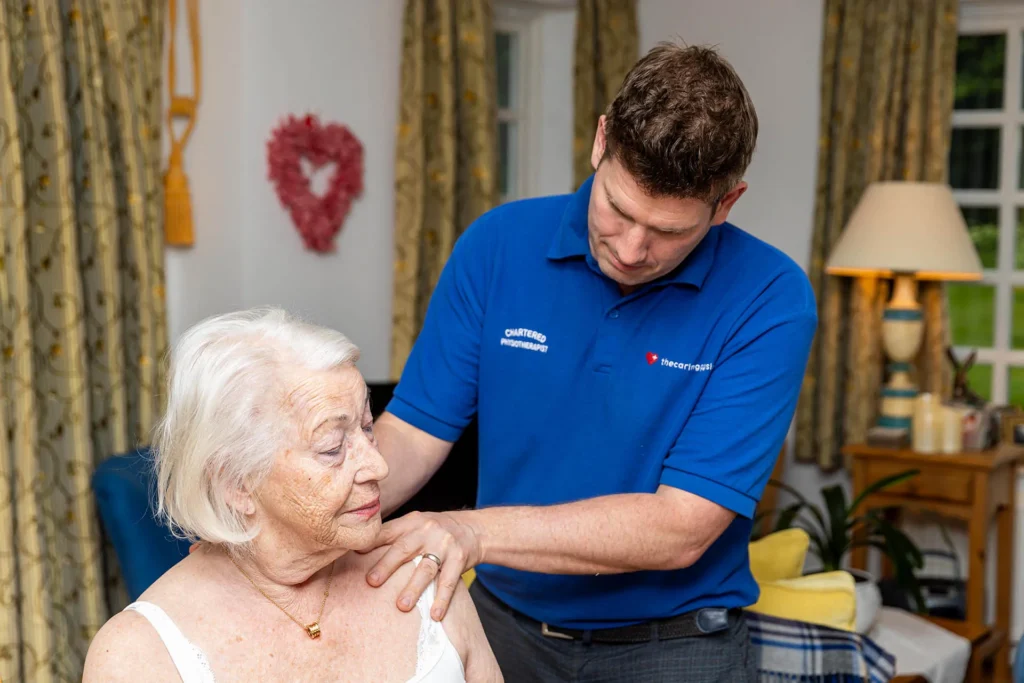
We provide home-visit physiotherapy across Morpeth and the villages around it, because recovery has to work on the stairs, the bathroom and the front step you actually live with. The physiotherapist who visits is chartered, whether you are at home or in a care home. Anyone can make the call, and there is no list of ours to join.
People ring us at different points. Most often just after a hospital stay — a new knee from Wansbeck General in Ashington, or a fortnight in a bed at Cramlington after a fall — coming home to Pegswood, Newbiggin-by-the-Sea or a lane outside Longhorsley. Sometimes from a respite bed, while everyone works out whether home is still possible. And often nobody has been to hospital at all: someone is getting weaker and the near-misses have started. That is hard to watch, and it is a far better moment to ring than after a fall. A fall, or a few weeks of not eating properly, is very often the start of the road that ends in a hospital bed. Keeping you off it is the whole point.
Our services in Morpeth include:
- Older people’s physiotherapy — steadier on your feet indoors and out, so the day stops being planned around the risk of a fall.
- Dementia physiotherapy — familiar routines used as the exercise, so walking and getting up from a chair stay safe for longer.
- Post-operative rehabilitation — getting going after a new hip or knee from Wansbeck General’s orthopaedic unit or Nuffield Health Newcastle Hospital.
- Neurological physiotherapy — stroke, Parkinson’s and MS, practised on the floors, steps and chairs of your own home.
- Respiratory physiotherapy — breathlessness and COPD, pacing the stairs and the walk to the shops so neither takes the whole morning.
- Muscle and joint pain — arthritis, a sore back or a stiff joint after a fracture, eased enough that moving stops being dreaded.
- Care home physiotherapy — a planned run of visits for residents in homes in Morpeth, Ashington and the coast villages.
- Rehabilitation for case management clients — longer-term rehabilitation after serious injury or surgery, planned with your case manager and reported back to them.
- Live-in rehabilitation care — someone living in with you to make sure the practice happens daily, not just on visit days.
Why families in Morpeth come to us
Morpeth is an old market town that a lot of people have retired into, and Ashington and the coast villages hold families who have been in the same street for three generations. What we are called about is usually small and specific rather than a diagnosis: the bank up from the river to the town centre has become too much, or the walk along the front at Newbiggin-by-the-Sea has quietly stopped happening. Families ring after a fall, or when a hospital stay has taken more than anyone expected it to. Across Northumberland, about a quarter of residents are now 65 or over, up from a fifth in 2011 (ONS, Census 2021), so more families here are facing these questions.
- Each physiotherapist who visits is chartered, HCPC registered and a member of the CSP.
- Ring us yourself: there is no referral to wait for and no waiting list of our own.
- Every session is a full hour, and nobody is watching the clock.
- Kind and conscientious, with people’s homes as well as the people in them.
- GPs, carers and families kept up to date, with a plain word when something is not working.
- Told something will not come back? We will take our own view and give it to you straight.
Before the first visit our office sends a short form to fill in, so the history is known and the hour goes on her rather than on paperwork. What we are looking for is the thing actually in the way. Sometimes it is strength. Often it is confidence, or pain nobody has got on top of, or exercises that never happen between visits. There is always time for some hands-on treatment and a first go at the exercises — it will not be the hardest session you have, but it is not an hour of talking either.
Morpeth, the coast and the villages we cover
Morpeth and the immediate villages
- Morpeth town centre
- Stobhill
- Lancaster Park
- Pegswood
- Hepscott
- Mitford
- Longhirst
The villages north and west
- Whalton
- Stannington
- Longhorsley
- Ulgham
- Widdrington
- Linton
Ashington and the coast
- Ashington
- Hirst
- North Seaton
- Woodhorn
- Newbiggin-by-the-Sea
- Lynemouth
- Ellington
- Cresswell
That covers most of NE61, NE63 and NE64. Pippa covers all of these, along with the rest of our Northumberland patch. Live out towards Rothbury, Otterburn or Hexham? Ring and ask; if we can get to you often enough to help, we will say so.
We also visit families in nearby Berwick-upon-Tweed. See all the areas we cover.
What Morpeth families most want back
Wansbeck General looks after the part that needs a hospital bed. Your own house is a different test. After a stroke, a broken hip or a bad infection, the real gains come in the weeks back at home, one ordinary task at a time.
- Back upstairs to your own bed, with the hired bed gone from the front room.
- The bathroom at night, and the commode back in the cupboard.
- Filling the kettle and carrying a hot drink through to the sitting room.
- Going back to whatever made the week worth having — market day in town, the bowls club, the allotment, church.
- Being left on your own for an afternoon without a daughter driving over from Ashington to check.
- Doing your share again: the pots, the post, the bird feeder.
Each of these matters more than it sounds. Every one changes how much help a day needs, so we work with carers and family to stop the gains slipping between visits. Out in the villages towards Longhorsley and Ulgham, home care is harder to staff and costlier to run than it is in town, so needing less of it counts for more here than most places.
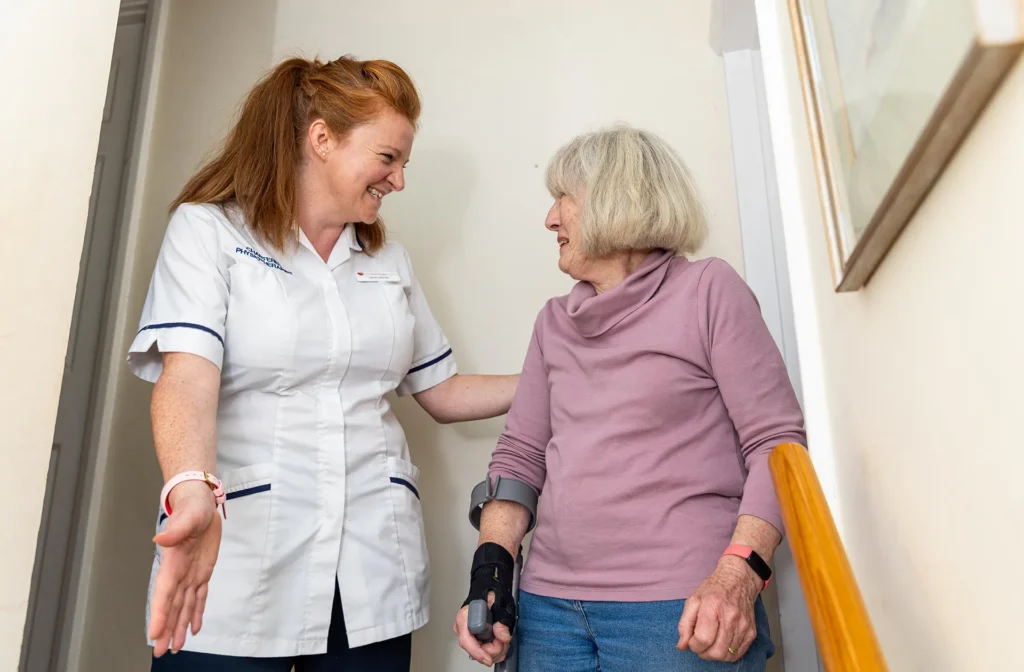
Wansbeck General can get you well enough to come home. It cannot practise the hill up from the river with you.
Morpeth has an NHS centre on Dark Lane — physiotherapy, x-ray, community nursing, speech and language therapy and orthopaedic clinics — but no inpatient beds. The beds are at Wansbeck General in Ashington, which has a care of the elderly ward, a stroke rehabilitation unit and the elective orthopaedic unit where hips and knees are replaced. Anything that begins as an emergency goes to the specialist emergency care hospital at Cramlington, twelve miles south. Wherever the stay starts, it ends the same way: a car ride home, and a house nobody has practised in yet.
That gap is our job. Tell us when she is due home and a first visit usually follows within one to five days, while there is still strength to build on rather than weeks of lost ground to win back.
Frailty can get better as well as worse.
In the British Geriatrics Society’s words, “The frailty state for an individual is not static; it can be made better and worse.” Frailty is preventable and modifiable — through exercise, nutrition, social connection and the management of long-term conditions — and many of the risks stay modifiable in later life. Which is another way of saying it is rarely too late to start.
How we close the gap
As soon as you have a date
Ring us with the discharge date and we book the first visit around it.
Off the hoist, back to using your legs!
We will give you more time to regain your confidence and change your equipment to help you stand again.
Exercises done together
No sheet of drawings left on the side. We practise them with you, adjust them as we go and make them harder as you get stronger.
Less help needed, not more
The stronger you get, the fewer calls you tend to need, and sometimes one carer instead of two.
Your Morpeth physiotherapist
Pippa is the chartered physiotherapist who visits people at home in Morpeth and the villages around it. She has worked in NHS frailty, stroke and neuroscience teams, and brings that experience to your own front room, building strength and confidence around the things you want to get back to.

Explore our physiotherapy services in Morpeth
FAQ - Your local questions
My mother is on a ward at Wansbeck General. Will you liaise with the team there before she comes home?
Yes, if she agrees. Most families on this page are waiting for someone to come home from Wansbeck General in Ashington, from the care of the elderly ward, the stroke rehabilitation unit or the orthopaedic unit. Our part starts with a call to the discharge team, and if it helps, a word with the nurses, occupational therapist and physiotherapist about what has been planned for home: carers, equipment, community physiotherapy. With that in hand we arrange her first visit for the first few days back. It is the same if the stay began at Cramlington. Where community physiotherapy has a queue, we start sooner and fit in alongside it.
My father lives in Morpeth but we are in Newcastle. Where does your cover stop?
Your father is well inside our patch, and so is most of what surrounds him. We cover Morpeth and the villages out to Whalton, Longhorsley and Ulgham, and north-east through Pegswood to Ashington, Newbiggin-by-the-Sea and the coast at Cresswell and Lynemouth. Beyond that, towards Rothbury, Otterburn or Hexham, give us a ring and we will be straight with you about whether we can get there. We cover Newcastle as well, so if you want to be there for the first assessment we can book it around the drive up.
My grandmother is 91 and very slow on her feet. Is it worth starting physiotherapy now?
Yes — age on its own is not a reason not to. The British Geriatrics Society is plain that frailty is not an inevitable part of ageing and that much of it stays modifiable in later life, which matches what we see: someone in her nineties who has spent three weeks in a chair after a chest infection usually has strength to get back, it simply comes back more slowly than it went. What changes at 91 is the goal, not the possibility. It might be standing from her own chair without a push, or getting to the bathroom in the night. We will tell you honestly at the assessment whether we think we can help.
My aunt gets tired and confused in the afternoons. Can visits work around that?
Yes, and we would rather work around it than push through it. If she is brightest mid-morning, that is when we come — there is no rota deciding it for us, and the same physiotherapist visits wherever we can, so we learn her pattern rather than meeting it fresh every week. Late-day confusion is common and it is not a reason to shorten the work; it is a reason to put the work where she can actually use it. If the pattern shifts, we move the visit. The point is that the session happens at the hour of the day that belongs to her.
My husband will not do the exercises unless I am standing over him. Does that mean it will not work?
No, and it is the commonest thing families tell us. Exercises on a printed sheet rarely happen, so we practise them with him and tuck them into his day: getting up from his armchair, the trip to the kettle, the back-door step. The routine carries it instead of his willpower having to. We show whoever else is there what helps and what to leave alone, so the repetition happens without it becoming your job to nag him into it.
Do you visit the villages — Mitford, Ulgham and Cresswell?
Yes, all three, and the rest of them. Mitford, Hepscott and Longhirst are a few minutes out of Morpeth; Ulgham, Widdrington and Linton sit between the town and the coast; Cresswell, Lynemouth and Ellington are on the coast road north of Newbiggin-by-the-Sea. Village addresses are much of the reason a service like this exists here — there is no bus that makes a twice-weekly outpatient appointment at Morpeth or Ashington realistic from a farm road, and the travelling undoes a fair part of what the appointment achieves. If you are not sure whether your lane counts as covered, ring and ask for a straight answer.
My mother has stopped walking into Morpeth on market day and only gets as far as the end of the garden. Is that worth a call?
Yes, and the sooner the better. Giving up the walk into town usually means leg strength, balance or confidence has begun to fade, and all three can be rebuilt with the right practice, whatever her age. We would come to the house, watch her on the garden path and the kerb outside, and shape a short daily routine around one goal: getting back onto Bridge Street. Anyone can ring on her behalf, and no doctor’s letter is needed. Pippa is in Morpeth, Pegswood and the nearby villages every week, so arranging a first visit is straightforward.
Local support in Morpeth
Alongside physiotherapy, these are the local services Morpeth families most often ask us about.
Age UK Northumberland — the county’s older people’s charity, based at The Round House on Lintonville Parkway in Ashington, with information and advice, care at home, day centres and lunch clubs, befriending and advocacy.
Live Well with Dementia groups, Age UK Northumberland — free sessions for people in the earlier stages of dementia, meeting at Morpeth Methodist Church on Howard Terrace on Monday mornings and at The Round House in Ashington on Tuesdays.
Northumbria Healthcare palliative and end of life care — symptom and pain management alongside physical, social and emotional support for adults with life-limiting conditions and their families, by referral from a GP or hospital consultant.
Onecall, Northumberland County Council adult social care — ring 01670 536400, day or night, for a care needs assessment, equipment or care at home. Council help and private physiotherapy often run together.
Care homes in Morpeth
Homes around Morpeth and Ashington run from large national groups to small independent houses — Northlands on Kings Avenue, Ashington Grange on Moorhouse Lane and Woodhorn Park on Woodhorn Road among them. To check a home’s current rating, use the CQC register; the county council does not publish its own list. Any of them, and others nearby, we are glad to visit.
Families usually arrange it privately: often a short course after a fall or a spell in Wansbeck General, sometimes a regular slot to keep someone walking. We fit around the home’s own care and show staff how to keep the exercises going on the days we are not there. More on physiotherapy for care home residents.
Manage a home in Morpeth or Ashington? Talk to us about a regular physiotherapy slot for your residents.
Pippa’s rounds fan out from Morpeth: south-east towards home physiotherapy in Blyth, and down the A1 to home visit physiotherapy in Newcastle. Unsure whether your address is in reach? Check every area we visit.