
Post-Operative Physiotherapy at Home
Chartered physiotherapists, HCPC registered, visiting you at home after surgery. No referral needed.
Get in touch today
If you have any questions or to see how we can help
Recovery happens at home now
Hospital stays after surgery are shorter than they have ever been. Someone having a hip or knee replaced is often up on their feet on the day of the operation or the next, and home within a few days. That is good practice, but it means most of the recovery now happens in the house rather than on the ward, and usually without a physiotherapist in the room.
That is where we come in. We visit you at home, usually within a few days of discharge, and work on the things that decide whether an operation was a success in daily life: the stairs, the bed, the toilet, the front step, the car and the walk to the shops.
Why so many people feel lost when they get home
Before an operation, most of your attention goes on the operation itself. Will the anaesthetic be all right? Will the operation go well and have no complications? There is a lot of anxiety, and very little room left for thinking about afterwards.
Then everything happens quickly. The consultant comes round while you are barely awake, says a great deal, and you may not see them again until your six-week check. The ward physiotherapist gets you up, shows you how to use the crutches and takes you up and down the stairs. A nurse gives you a list of medicines and things to do. And before you know it, you are home.
You were given the right information. It is just a lot to take in at the one time you are least able to take it in. Once home, people are often sore, sleeping badly and unsure what they should be doing. The question is usually how much. How far should I walk? How often should I do the exercises? Is this pain normal?
Most people fall into one of two camps. Some are frightened that doing too much will damage the new joint and undo the operation, so they do very little, and lose strength they will have to rebuild later. Others find it hard to slow down, do far too much on a good day and pay for it with swelling and soreness, because they have not given their body time to recover. We are good at talking people through this. We go back over what the hospital told you, in your own home and at your own pace, and set out what the right amount looks like for you this week, and next week.
Planned surgery: hip, knee, shoulder and spine
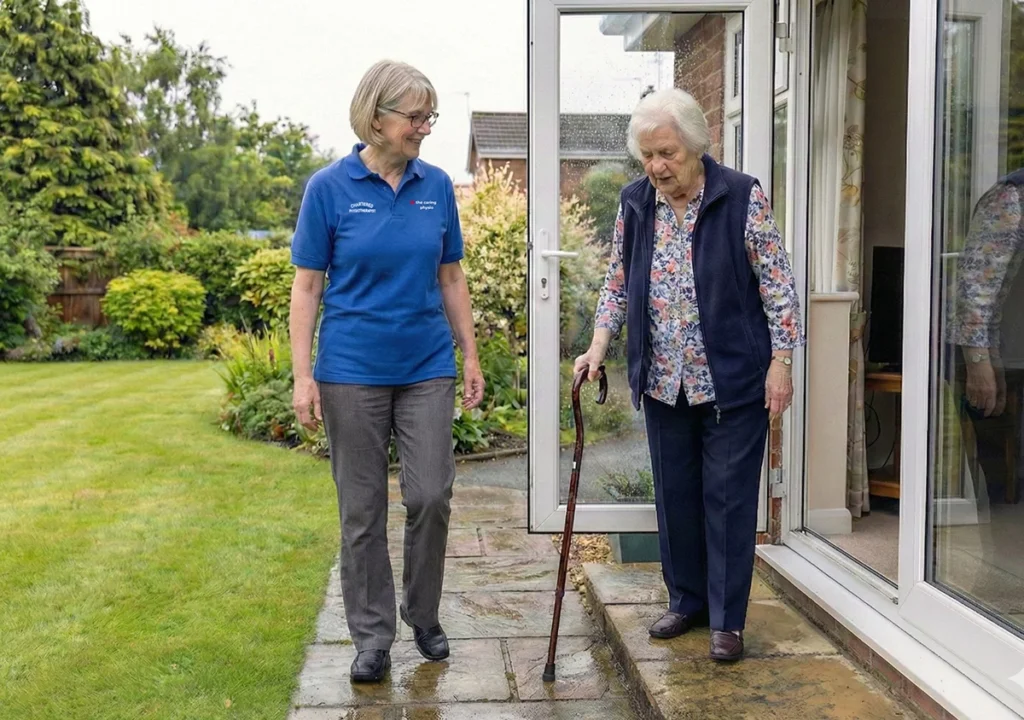
Most of the people we see after planned surgery have had a total or partial hip replacement, a knee replacement, a shoulder replacement, or back surgery such as a decompression, discectomy or fusion.
The hospital usually sends you home with an exercise sheet and a set of rules. The exercises matter more than anything else you do, and they are the first thing to slip once the pain, the tiredness and the swelling set in. NHS guidance is that most people move from crutches to a stick, try walking without an aid at around six weeks after a knee replacement, and wait at least six weeks to drive. Full recovery takes several months, and longer for some.
Those months are where we make the difference.
- Getting the knee to bend and straighten. A new knee that stiffens in the first six weeks is much harder to recover later, so we measure it and work on it at the right rate.
- Hip precautions, applied to your house. What “no bending past ninety degrees” means for your chair, your bed height and putting your shoes on.
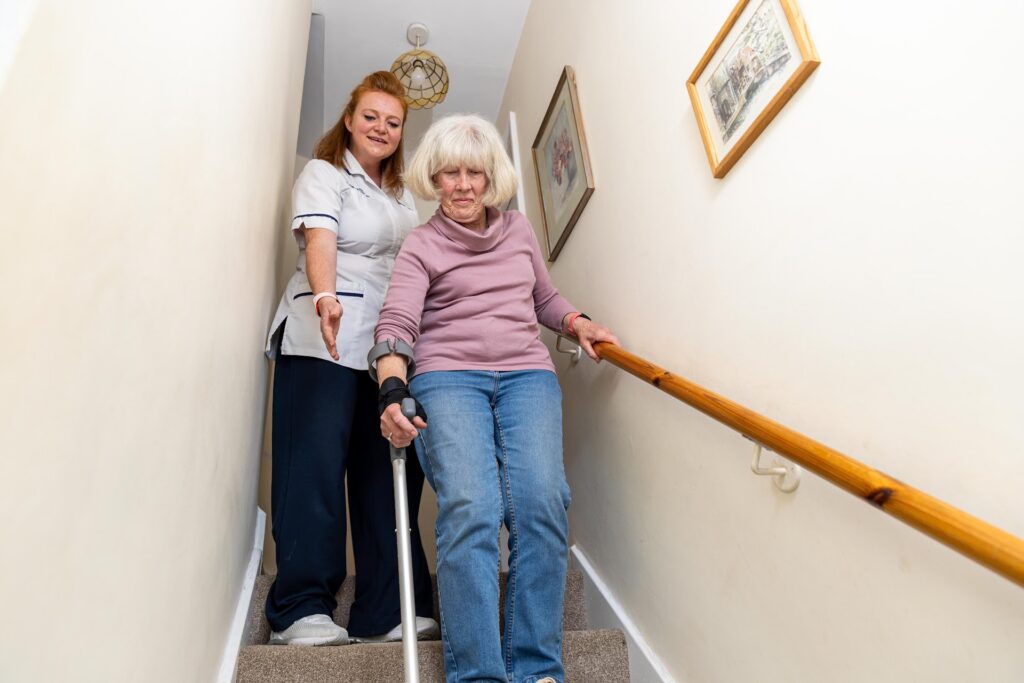
- Stairs, safely. Up with the good leg, down with the operated one, until it becomes automatic.
- Coming off the frame and the sticks at the right time, and not before.
- After spinal surgery, building back walking distance and sitting tolerance, and the trunk strength that the pain had taken away long before the operation.
We work within whatever your surgeon has specified, and we contact them or your GP if something is not right: a wound we are unhappy with, a calf that is swollen and tender, or pain that is getting worse instead of better.
Working alongside your hospital team
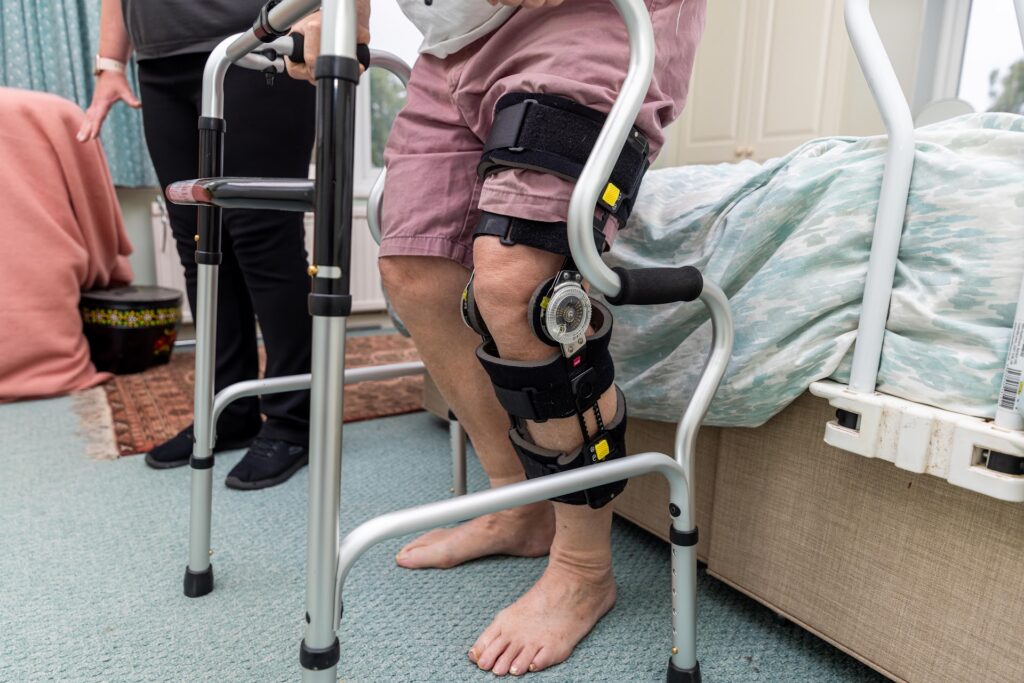
We work alongside NHS and private hospital teams, not instead of them. We read your discharge letter, follow the plan and the precautions your consultant has set, and with your permission we keep your consultant, your GP or your outpatient physiotherapist up to date with what we are doing.
It does not matter where you had your operation. We see people at home after surgery at their local NHS trust hospital and at the large private hospital groups, including Spire, Circle Health Group, Nuffield Health, Ramsay Health Care and HCA. Many NHS operations are now carried out in private hospitals too. Wherever it was done, we follow your consultant’s plan.
Many people are booked to go back to the hospital physiotherapy clinic after their operation. But the first appointment can be a week or two away, and in those first weeks getting there is often the hard part: you cannot drive, the car is difficult to get in and out of, and the walk from the car park is further than you can yet manage. We can visit you at home in that gap, so the early work on the joint and on getting about the house is not missed. When you are ready to travel, we write a report for your consultant and the hospital physiotherapy clinic, so they know exactly where you have got to.
If you had your operation privately, your package may include five or six follow-up physiotherapy sessions at the hospital. If getting there is too much in the first two weeks, because you cannot get into a car yet or the pain makes going out a struggle, we can see you at home in that time. You pay us for those visits and still keep your hospital sessions for when you are ready to travel, so you do not miss out on the early weeks.
Getting home, and getting back upstairs
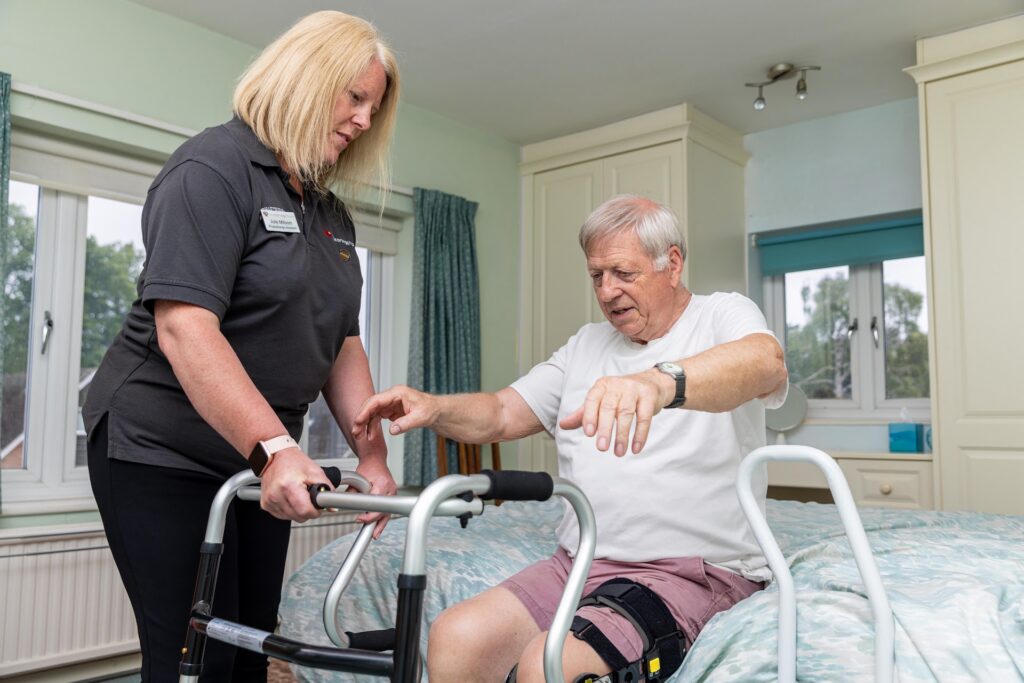
Before you leave hospital, we can work with the discharge team so the right equipment is ready for you at home, such as a raised toilet seat, a perching stool, a frame for each floor, or a bed downstairs for the first few weeks. Once you are home, we show you how to use it safely and check that it suits your house.
Many people come home to a bed in the living room because the stairs are too much for now. That is sensible at first, but most people want their own bedroom and their shower back as soon as they can. We practise the stairs with you, step by step, until you are ready to get back to living upstairs and washing properly again.
After a broken hip or other fracture
A broken hip is not a planned operation, and recovering from one is a different job. More than 70,000 people break a hip every year in England, Wales and Northern Ireland. Most are older people, often in their eighties, most broke it in a fall, and many were already managing with less strength and balance than anyone had realised.
National standards say rehabilitation after hip fracture surgery should start no later than the day after the operation and happen at least once a day. The national hip fracture audit also found that more than a quarter of hospitals offer physiotherapy on weekdays only. And once someone is home, therapy often thins out just as the real work starts.
After a fracture we work on two things at once. The first is recovery from the operation: walking, stairs, getting on and off the bed and the toilet. The second is the reason for the fall: balance, leg strength, medication, eyesight, the rug in the hall, the trip to the bathroom at night. A second fall in the months after a hip fracture is what families fear most, and preventing it is part of the job, not an extra.
Many of the people we see after a fracture are frail, are living with dementia, or have been told they have limited rehabilitation potential. That is our main area, and you can read more about our physiotherapy for older people. We also explain why a fortnight in hospital takes so much out of someone in our help and advice section.
We also help after other fractures, including a broken wrist, shoulder or pelvis, and fractures that were treated without an operation.
After heart, chest, bowel and general surgery
Not every operation is about bones and joints. We also see people at home after:
- Heart surgery, including bypass grafts and valve replacements. The breastbone takes around three months to heal, and hospital advice is usually not to lift anything heavier than a half-filled kettle in the meantime. Cardiac rehabilitation classes usually start two to six weeks after discharge. We work alongside them, and we help the people who cannot yet get to a class, or who have come home weaker than the programme expects.
- Bowel and abdominal surgery, including bowel cancer surgery and emergency operations. Deep breathing, early walking and protecting the wound all matter, and heavy lifting is usually off the list for eight to twelve weeks. We help build walking distance back up in the house before someone is expected to manage outside.
- Chest and lung surgery, and anyone whose operation was followed by a chest infection. Breathing exercises, clearing the chest and managing breathlessness are part of our respiratory physiotherapy.
- After intensive care. A stay in intensive care can leave someone with profound muscle weakness and exhaustion, and getting back to full strength often takes many months. The follow-up clinic, where there is one, is usually two to three months away. We start in the house long before that.
The first weeks home: why recovery stalls
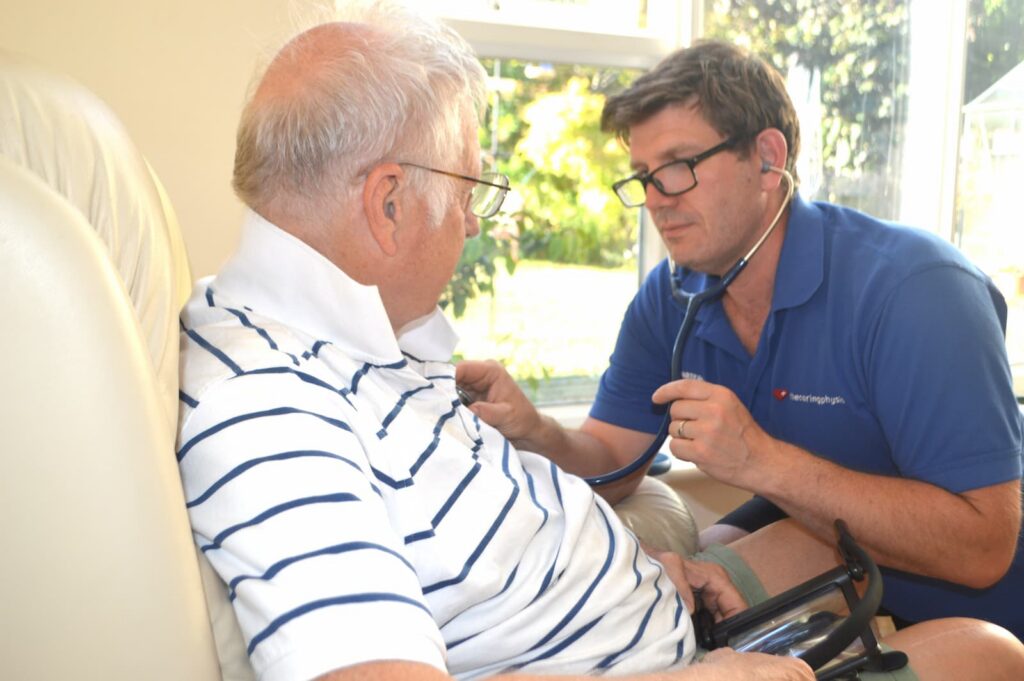
Pain is the start of most of it. After an operation, pain stops people moving, and moving less sets off a chain. Muscles weaken within days, the heart and lungs lose fitness, and everyday things like the stairs or the walk to the kitchen start to feel like hard work. Confidence goes with it.
Managing pain well is how that chain gets broken. We look at when you are taking your pain relief and how it fits with the times you need to move, and we tell your GP if the pain is not controlled well enough for you to do what you need to.
Breathing and your chest
After abdominal, chest or heart surgery especially, a deep breath or a cough can hurt, so people breathe shallowly and avoid coughing. Moving about makes us breathe more deeply without thinking about it; sitting still for most of the day does not. Shallow breathing lets the bottom of the lungs close down and phlegm settle, which is how chest infections start. Regular deep breathing exercises, and learning to cough with a pillow held firmly over the wound, keep the lungs open and clear.
Circulation and blood clots
Sitting still also slows the blood in the legs. A clot in a deep vein of the leg, a DVT, can form weeks after surgery, and if part of it travels to the lungs it causes a pulmonary embolism, which is an emergency. Moving your ankles regularly, getting up and walking every hour or so, drinking enough and taking any blood-thinning medicine exactly as prescribed all lower the risk.
Infections to watch for
Chest infections and urinary tract infections are both common after an operation, especially if a catheter was used. In older people a urine infection often does not show up as pain. It shows up as new confusion, a change in behaviour or suddenly being unsteady on their feet. Drinking enough to keep urine pale helps prevent it. We watch for all of these at every visit, and we contact the GP the same day if something is not right.
Coming home from hospital: a checklist
- ☐ You know what pain relief you are taking, when, and for how long, and it is timed so it is working when you need to move
- ☐ You have the hospital exercise sheet and you are doing the exercises as often as it says
- ☐ Five slow, deep breaths every hour while you are awake, and a supported cough with a pillow over the wound
- ☐ Ankle pumps whenever you are sitting, and up and walking every hour or so during the day
- ☐ Blood-thinning injections or tablets taken exactly as prescribed, for as long as prescribed
- ☐ Enough to drink to keep your urine pale
- ☐ The bed, chair and toilet are at a height you can get up from safely, and the hospital equipment is set up where you need it
- ☐ A clear route to the bathroom at night, with a light you can reach
- ☐ Phone numbers to hand for the ward or surgical team, your GP, and us
Get help straight away
Call 999 if you suddenly become short of breath or have chest pain.
Contact your GP or NHS 111 urgently for a calf that is swollen, painful, warm or red; a high temperature; or new confusion, burning when passing urine or sudden unsteadiness.
If you are worried about your wound, for example it is hot, red, oozing or opening, call your GP surgery, which may be able to send a nurse out to see you. If you have the number for your consultant’s secretary, it can also help to contact them directly.
What a home visit looks like
The first visit is an assessment in your own home and usually takes around an hour. We read the discharge letter, look at the wound and the swelling, watch how you get in and out of bed, on and off the toilet and up the stairs, and ask what you want to get back to. Then we agree a plan together.
After that, a course might include:
- Exercises set for your stage of recovery and for your house, filmed on your phone if that helps
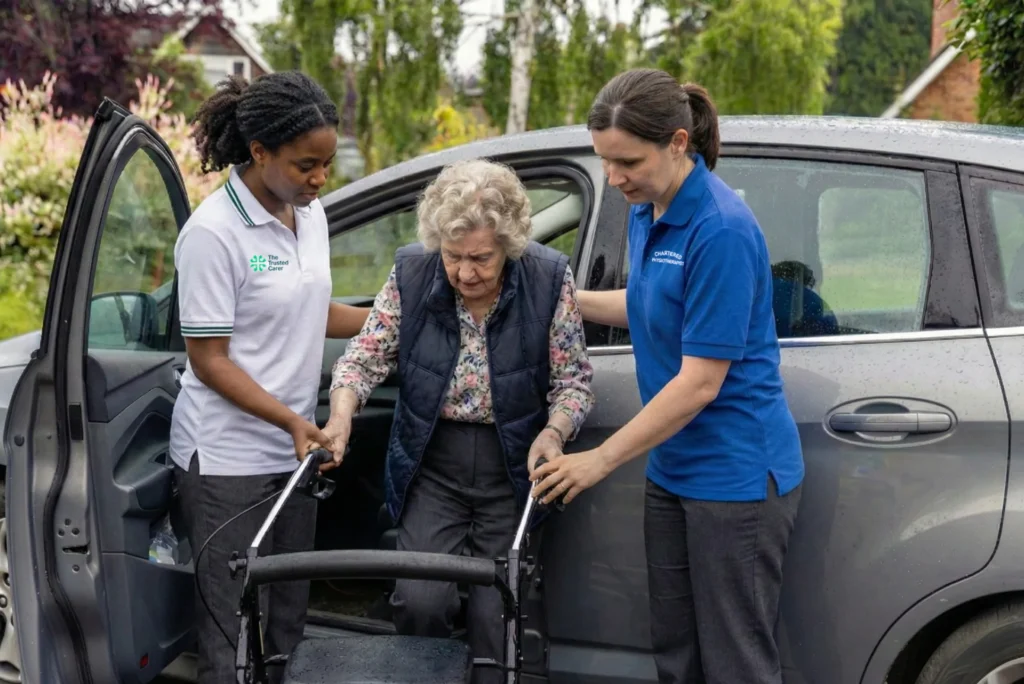
- Practising the stairs, the bath or shower, and getting in and out of the car
- Walking outdoors, from the front step to the end of the road and then to the shops
- Checking the equipment the hospital provided, and whether it still fits the job
- Showing family or carers what to help with and, just as important, what to leave the person to do
- Writing to your surgeon or GP when something needs a doctor
How many visits depends on the operation and the person. Some people need three or four visits to get their confidence back; others need weekly visits for several months.
What patients say after their operation
I’ve just had a total knee replacement and knew that physio was a vital part of my recovery. Unfortunately as we know, the NHS don’t provide post operative support other than at week 6 – by which time I could have been doing all sorts wrong. For my own reassurance I got in touch with the Caring Physio who found a physiotherapist to come to my home. She was so brilliant at telling me what to expect, what I should be doing, pushing me to do more but also telling me when I’d walked too far for example! Without her advice and encouragement I would have had six very long weeks when I could easily have persuaded myself that my pain was far worse than other people’s and therefore should rest more. Thank you Eleanor for being my support at a very tough time. I would really recommend the Caring Physio. They responded quickly and with sensitivity to my needs.
— Faye W. · total knee replacement, supported at home by Elena M.
I cannot speak, highly enough of The Caring Physio. Having had spinal fusion and decompression, followed by one week in a rehab home, I found myself four weeks, post operatively, returning home immobile, with no support. Looking for a visiting physio, I contacted The Caring Physio website, left a message and had an immediate response from Will Ferguson, the Clinical Director, who was sympathetic and extremely knowledgeable. … As I was unable to walk, he arranged for three visiting physios the first week in order to give me maximum support. All three or them were of the highest calibre – warm, reassuring, encouraging and very professional. … At the age of 75. My progress has been slower than some, but the encouragement and confidence I receive from Caring Physio has given me the much needed reassurance to believe that I shall be walking properly before too long.
— Jane M. · spinal fusion and decompression, with Will Ferguson and the team
I have received great care from Dom and Will at the Caring Physio. They have provided me with regular sessions and lots of helpful advice and expert knowledge that has aided my recovery and helped me to push on with my rehab. This is after a very severe break to my heel bone and additional bone infection. A year after being told my best option was BKA by a consultant I am now able to cycle again, go to gym and cycle. Many thanks for your help!
— J.B. · severe heel fracture and bone infection, after being told a below-knee amputation (BKA) was the best option, with Dom M. and Will Ferguson
I had a great service from the Caring Physio when recovering from an ankle fracture and surgery. Michelle visited me at home when I was housebound and helped me regain confidence in moving around the house and eventually walking. She arrived on time, offered practical advice, encouragements and a program to follow every sessions. I recommend this company. Thank you for putting me back on my feet (literally)
— Estelle H. · ankle fracture and surgery, with Michelle M.
I contacted Caring Physio on discharge from hospital following heart surgery and had prompt and timely visits from Jill, who covers Leamington Spa. She gave me thoughtful and invaluable advice and much encouragement.
— John K., Leamington Spa · home after heart surgery, with Jill N.
I contacted Caring Physio after a full right knee replacement at Royal Berkshire Hospital (RBH) Reading. I was discharged after 3 days of my operation with only a set of notes on Exercises to do – there was no Physio option from RBH. I found the more advanced exercises impossible to do due to swelling and numbness of my knee. So, I contacted Caring Physio as I needed some assistance to progress my knee recovery. They sent me Dominic who was very knowledgeable and attentive. He had apparatus to compare good knee to bad knee so we had a benchmark to work with. Over the next two weeks Dominic tested my bad knee, gave me new set of exercises and gradually made them more advanced. In two weeks I made very good progress. … If you need some assistance to progress from your operation you will find them excellent. My advice – give them a go!
— Brian T. · knee replacement at the Royal Berkshire Hospital, with Dom M.
Before the operation
If you have a date for a planned operation, it is worth seeing us beforehand. Going in stronger usually means coming out better. We strengthen the muscles that will be doing the work afterwards, practise with the walking aids before you need them, and look at the house, from the bed height and the chair to the stairs and the bathroom, so it is ready for the day you come home.
Paying through private health insurance
We accept private health insurance, but please check with your insurer before your first visit. Not every insurer covers home visits. Insurers are set up around clinic appointments at fixed prices, and a physiotherapist travelling to your home is priced differently.
Aviva and WPA accept our home visits. Some other insurers only cover home visits on their top-level plans. Ask your insurer whether your policy covers home-visit physiotherapy and whether you need an authorisation code, and have it to hand when you call us.
You pay us directly and then claim the cost back from your insurer. We do not bill insurance companies ourselves, so keep your invoices for your claim.
If your rehabilitation follows an accident or serious injury and a case manager is organising it, see our physiotherapy for case managers page.
Book a home assessment
No GP or consultant referral is needed. Ring us with the date of the operation or the discharge, and we will arrange the first visit around it. Our fees and the mileage charge are set out on our FAQ page. Call 0800 772 0542 or send us a message.
Areas we cover
We visit people at home after surgery across twenty counties in England: Bath and North East Somerset, Berkshire, Bristol, Buckinghamshire, Cambridgeshire, County Durham, East Sussex, Gloucestershire, Hampshire, Hertfordshire, Lancashire, London, Merseyside, North Somerset, Northumberland, Oxfordshire, Surrey, Tyne and Wear, Warwickshire and Wiltshire. You can find your nearest team on our Areas We Cover page.
If your area is not listed, please still get in touch. We can often help in neighbouring areas.
Explore our other physiotherapy services
Post-operative physiotherapy FAQs
How soon after an operation can you start?
Usually straight away — and the first fortnight home is the most valuable window there is. We take referrals before discharge as well as after, so tell us the date when you have it and we will book the first visit into that first week. Starting early is not about pushing harder; it is about not losing ground that then has to be rebuilt.
Which operations do you commonly help people recover from?
Hip and knee replacements, hip fracture and other fracture repairs, shoulder surgery, spinal surgery, and major abdominal or cardiac procedures where the problem afterwards is deconditioning rather than the wound. We also see a lot of people recovering from revision surgery, where the rehabilitation is longer and the expectations need handling honestly.
The hospital gave me exercises. Why would I need a physiotherapist as well?
Because a ward has a different job. Ward physiotherapy gets you safe enough to leave — walking a few steps on a flat floor with staff at hand and rails in the right places. Getting back to yourself is a longer piece of work in a harder building. Your hallway has a rug, a turn at the bottom of the stairs and nobody standing behind you. That gap is where most of the recovery actually happens.
My relative had their operation weeks ago and seems to have stalled. Is it too late?
No, and stalling is common rather than a bad sign. Progress after surgery is rarely a straight line, and a plateau usually means the programme has stopped matching where somebody is — too easy, too hard, or aimed at the wrong thing. We would reassess from scratch rather than assume the original plan still fits.
Will you push too hard? I am worried about the new joint.
It is the right worry and it is the wrong outcome to fear. Working at the right level is most of the skill in this job — hard enough to make a difference, not so hard it sets you back. We work within whatever the surgeon has specified, we watch the wound and the swelling, and we would rather go slower for a fortnight than lose a month to a flare-up.
Do I need a referral from my surgeon or GP?
No. We are chartered physiotherapists and you can contact us directly, before or after the operation. With your permission we are glad to write to your surgeon or GP, and we will always do so if we find something that needs a doctor — a wound we are not happy with, pain that is not settling, or swelling that is behaving oddly.
Can you help me prepare before the operation as well?
Yes, and it is worth doing. Going into surgery stronger means coming out of it better — less time on a frame and less to rebuild. Prehabilitation work concentrates on the muscles around the joint and on the practical things you will need on day one at home: getting off a bed, managing your own stairs, getting in and out of a car.
How many visits will it take?
Most people need a concentrated run — often weekly for six to eight weeks — and then far less. It depends more on where somebody starts than on which operation they had. We measure at the first visit so progress is a fact rather than an impression, and we say plainly when the work has stopped adding anything.
What if the recovery is not going the way we were told it would?
Then it is worth looking properly at why, rather than waiting. Sometimes it is pain nobody has got on top of. Sometimes it is confidence rather than the joint. Sometimes a goal was set that was never realistic. We will assess, tell you what we think, and be honest with you either way — including when the honest answer is that you should go back to the surgeon.
Can you show my family what to help with?
Yes, and it makes a real difference. One visit a week does not undo the other six days, and the people around you can either help the recovery along or, with the kindest intentions, quietly take it over. We show whoever is there what helps and what to leave alone. Our fees are published in full on the pricing page.
Still have a question?
Every operation and every recovery is different, and the answer you need may not be here. Ring us and talk it through with a physiotherapist before you decide anything. There is no obligation, and if we are not the right people to help, we will tell you who is.
It helps to have these to hand when you call
- The date of your operation, or your discharge date
- Your discharge letter or exercise sheet
- Any precautions your consultant has given you
- Which floor you are living on for now, and what equipment you have
- Your insurer and authorisation code, if you are claiming
Every Caring Physio physiotherapist is
- HCPC registered and a member of the Chartered Society of Physiotherapy
- DBS checked and fully insured
- Used to working alongside NHS and private hospital teams