
Home Visit Physiotherapy in Woking
Get in touch today
If you have any questions or to see how we can help
Physiotherapy at home in Woking and the surrounding villages
We provide home-visit physiotherapy across Woking, Knaphill, the Byfleets and the villages in between. Our chartered physiotherapists come to you at home or in your care home. There is no clinic to travel to and no waiting list.
Most families ring us before anything has gone wrong. A father in Horsell has stopped going down the garden; a mother in Knaphill holds the furniture from room to room, and everybody can see where it is heading. The best time to ring is before the fall, not after it — the right exercise cuts the rate of falls by around a quarter, and by a third when balance and strength work are combined. Others ring with someone still on Heron Ward at St Peter’s after a broken hip, or home with Parkinson’s that has turned the walk to the car into a two-person job. It is hard to lose what you could do last year, and hard to watch. There is no dignity in being lifted from a chair you used to get out of yourself. Getting that back is the work.
Our services in Woking include:
- Older people’s physiotherapy — falls, balance and the confidence to go out on your own again.
- Dementia physiotherapy — staying steady on your feet and safe in and out of a chair, at home or in a care home.
- Post-operative rehabilitation — after a hip or knee replacement at St Peter’s, or privately at the Nuffield on Shores Road.
- Neurological physiotherapy — for stroke, Parkinson’s and multiple sclerosis (MS), carried on at home once the hospital stay ends.
- Respiratory physiotherapy — for breathlessness and COPD, so the stairs stop needing a rest halfway.
- Muscle and joint pain — arthritis, back pain and the stiffness that follows a fracture.
- Care home physiotherapy — regular visiting sessions for residents across Woking and the villages.
- Case management clients — complex post-surgical and long-term rehabilitation, with reports a case manager can use.
Why families in Woking come to us
Woking has grown quietly older. The borough has about 103,900 people, and the number aged 65 and over rose by 15.2% between the last two censuses. A lot of the people we visit have lived in Horsell, Old Woking or the Byfleets for decades. Their children often work in London or further away, and cannot simply pop round. The town centre and the canal towpath are flat, but Knaphill, Brookwood and Pyrford are a drive apart. For anyone who has given up the car, the borough’s Bustler dial-a-ride becomes the difference between going out and staying in.
- Chartered physiotherapists — HCPC registered, CSP members, and insured for home and care-home work.
- We come to you, at home or in the care home — no taxi, no waiting room, no tiring trip before the work even starts.
- Problem-solvers first — if the usual approach will not work in your house, we find one that does.
- Older people are not a sideline for us. It is the whole job.
- We explain what we are doing and why — to you as well as to your relative.
- We do not write people off. If you have been told something is not possible, we will look again and be honest either way.
The first visit is a proper assessment, and it always includes treatment — nobody pays for an hour of talking. The office sends a short form out beforehand, so the medication, the history and any recent stay at St Peter’s are known before we arrive. We spend that hour finding out what is really in the way of the thing your relative wants back. Usually it is lost confidence, or pain that has never been properly managed, more than any lack of strength. And because one visit a week cannot do it alone, we work out with you who else can help on the other six days.
Your physiotherapists in Woking
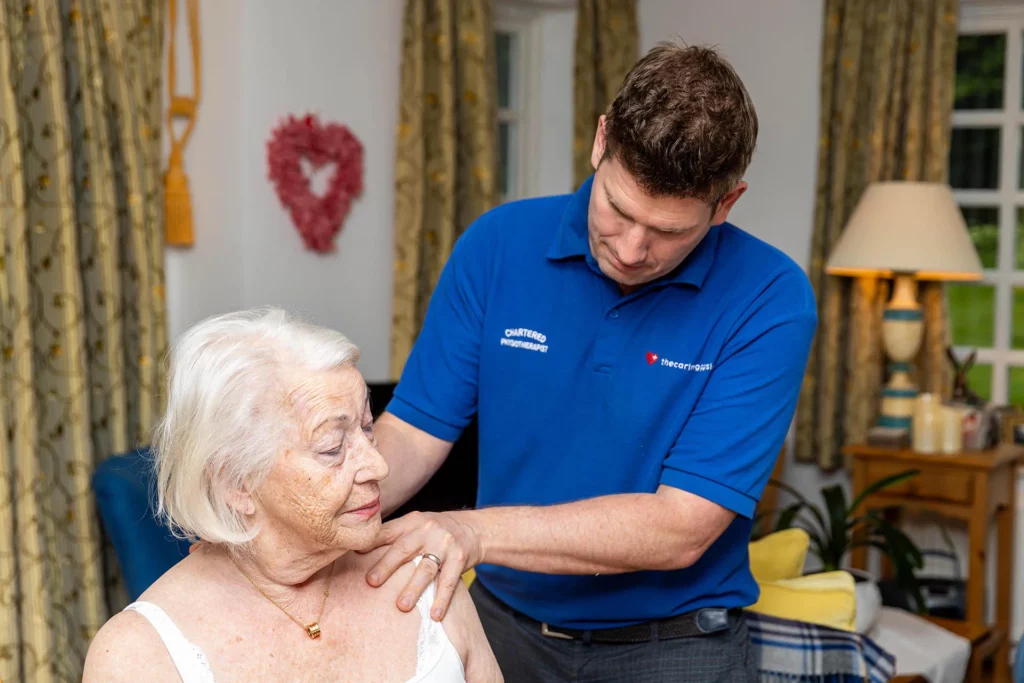
Helen C. has been a chartered physiotherapist since 2005 and lives just outside Woking. She knows the local hospitals from the inside, having worked at Ashford and St Peter’s as an outpatient physiotherapist and acting clinical lead. Before that she spent ten years seeing private patients in their own homes, and a stretch in trauma and orthopaedics at St George’s, where she worked with people recovering from complex multiple injuries. A new hip, a fracture, or a run of falls that has knocked someone’s confidence — Helen has seen most of it, and she keeps her sense of humour while she works.
Natalie W. has been a chartered physiotherapist since 2007 and has spent most of the last decade in NHS community and rapid-response teams, seeing people at home to keep them out of hospital or to get them going again after it. She led a hospice physiotherapy service, where she ran a group for people living with breathlessness and fatigue, and she is a qualified postural stability instructor — the falls-prevention programme for older people. She lives in Surrey and covers Woking alongside Guildford and Berkshire.


What families say about Helen and Natalie
“the work that Natalie has done with Robert has been tremendous … Natalie always brings sunshine with her when she visits and it is a pleasure to have her working with Robert.”
Nicholas M., Surrey & Berkshire · walking and falls confidence with Natalie W.
“My physiotherapist, Helen, is outstanding and my condition, following a stroke, has improved remarkably. She is professional, intelligent, remarkably skilful and empathic. I could not wish for better therapy.”
Alan M., Surrey & Berkshire · stroke rehabilitation with Helen C.
“Having had sepsis resulting major surgery to my legs and hip I was only making very slow progress in recovery. … Helen treated me and provided home work for me. The results have been simply wonderful. I am now nearly as good as new!!”
Paddy T., Surrey & Berkshire · recovery after surgery with Helen C.
“Helen has provided caring and supportive treatment at home, provided positivity and purposeful exercises clearly explained as well invaluable advice around pain relief, walking aids, safety in the home etc.”
Ben H., Surrey & Berkshire · osteoporosis and mobility with Helen C.
Areas we cover in and around Woking
Woking and the inner villages
- Woking town centre
- Horsell
- Maybury
- Sheerwater
- Old Woking
- Kingfield
- Westfield
- Mayford
Knaphill and the west
- Knaphill
- Brookwood
- St John’s
- West End
- Bisley
- Chobham
- Goldsworth Park
- Hook Heath
The Byfleets and the east
- West Byfleet
- Byfleet
- Pyrford
- Woodham
- Send
- Ripley
That covers most of GU21, GU22 and GU23, and the villages towards GU24. If you are just outside — towards Weybridge, Addlestone or Lightwater — call us anyway and we will tell you honestly whether we can reach you.
We also visit families in nearby Guildford, Camberley and Godalming. See all the areas we cover.
The things people in Woking actually want back
Nobody rings us asking for better hip strength. They ring because something ordinary has quietly stopped, and the week has got smaller around it. These are the goals we hear most often in Woking:
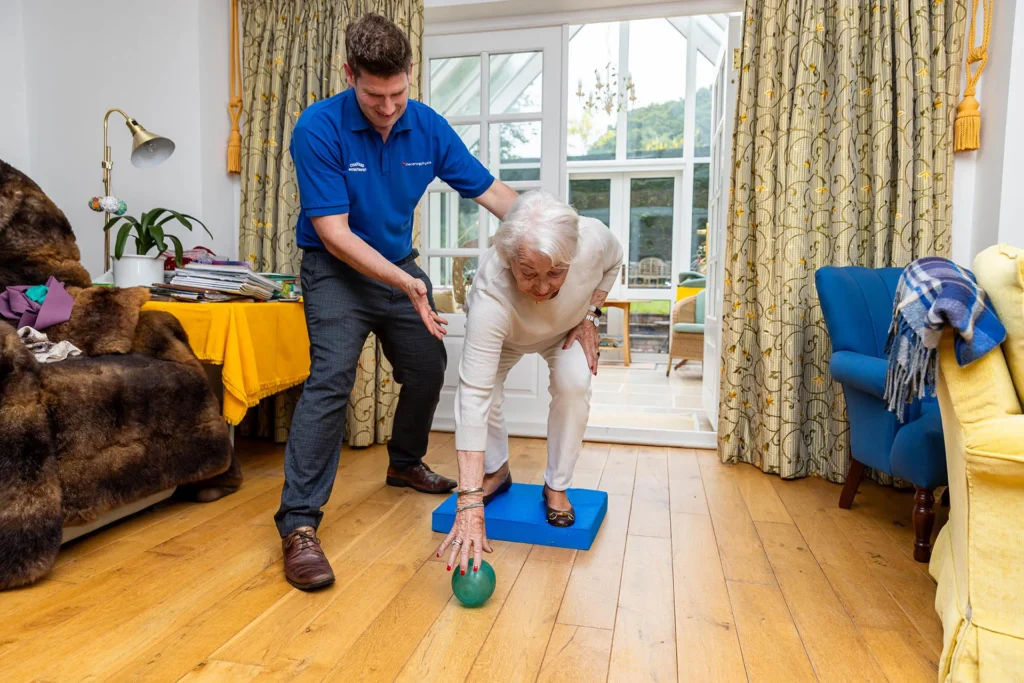
- Getting up from the sofa without rocking three times first.
- Washing at the basin standing up, without one hand on the edge.
- Making your own lunch and carrying it to the table.
- Once round Woking Park, sitting down because you fancy it, not because you have to.
- Getting to Sunday lunch, or the shops in Horsell, under your own steam.
- Opening the front door without the worry of falling on the other side of it.
Every one of these is specific enough to measure. We note where you are on the first visit, so improvement is something you can see written down, not just something we tell you.
Woking has the wards and the rehabilitation units close by. None of them has your hallway.
For most people here an emergency admission means St Peter’s in Chertsey. Hip fractures go to Heron Ward, other orthopaedic patients to Swan Ward, and strokes to the hyper-acute and acute unit on Aspen Ward. Some people come back through Woking Community Hospital on Heathside Road, where the Bradley Unit provides neurological rehabilitation and Central Surrey Health’s community rehabilitation team is based. Planned hips and knees are also done privately at the Nuffield on Shores Road.
Whichever route someone takes, there comes a day when the ward routine has become the familiar thing and home is the place that feels strange. That is the gap we close. Ring us with the discharge date and we will book the first visit around it.
Lying in bed has a cost
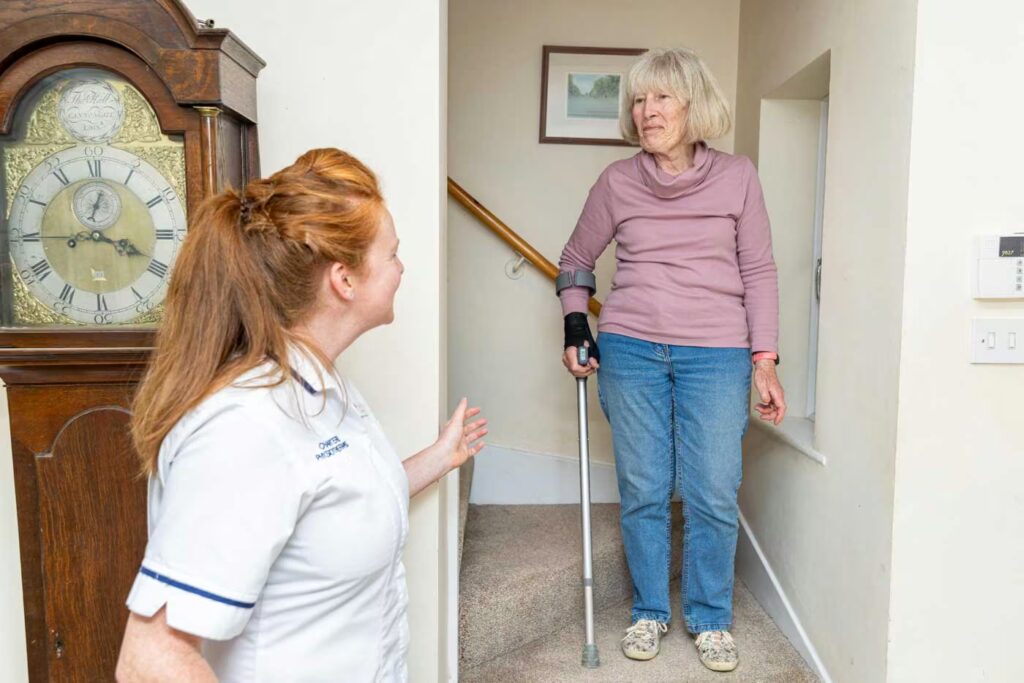
The local hospital trust puts it plainly: “there is extensive evidence that immobility in hospital leads to deconditioning, loss of functional ability and cognitive impairment.” The answer is the same one its End PJ Paralysis campaign gives — getting up, getting dressed and moving, every day. We carry it on at home.
How we close the gap
As soon as you have a date
Ring us with the discharge date and we book the first visit around it. The sooner we see you, the sooner your muscles start to strengthen.
Helped, not taken over
It is easy for anyone, with the kindest intentions, to do things for someone that they could still manage themselves. We work with families and carers so that the help builds independence back rather than quietly replacing it.
Along the towpath
The Basingstoke Canal runs flat right through the middle of Woking. A walk along it to the next bridge is a goal people choose for themselves, and one we can measure. We don’t just do our exercises inside, building up your confidence outside is so improtant.
Confidence comes back too
Most people can do more than they believe. A lot of the work is proving it, one small thing at a time — and an hour of decent company does more for that than it sounds.
Helping you recover using physiotherapy in the comfort of your home
FAQ - Your local questions
My mother is on Heron Ward at St Peter's after a broken hip. Can you see her before she comes home?
Usually yes, with the ward’s agreement, and it is worth asking for. Seeing someone at Heron Ward at St Peter’s before discharge tells us things a phone call cannot — how she actually transfers, how far she walks with the therapy team, and what she is like at four in the afternoon rather than at her best. Then the first visit at home starts from where she is rather than from a blank page. If there is no time for that, it changes nothing important; we simply do the finding-out on day one instead. Either way, ring us with the date as soon as you have it.
My father has been in a wheelchair for two years. Is it too late to try standing again?
It is not too late to look, and looking honestly is the point. The longer somebody has not done something, the more impossible it feels — that is normal, and it is not evidence that nothing can change. What has usually been missing is time rather than potential: enough weeks to rebuild the strength and the confidence that standing needs. We would assess what is actually in the way, work at it properly, and tell you plainly either way. We will never promise a particular outcome, but we have not yet met anybody with nothing at all to work with.
My grandmother gets tired and muddled in the afternoons. Can visits work around that?
Yes, and they should. Sundowning is real and there is no sense fighting it — if she is at her best at ten in the morning, that is when we come. We would rather have a good hour at the right time than a difficult one at the wrong one, and we will move a regular slot if her pattern changes. The same applies to anything else that shapes the day: carer calls, meals, a day centre, a bad night. Tell us how the day actually runs in Horsell or Knaphill or wherever she is, and we work around it.
My dad is in West Byfleet and we are over in Weybridge. Where does your cover stop?
West Byfleet is comfortably inside our Woking area, and so are Byfleet, Pyrford, Send, Mayford, Horsell, Knaphill and Brookwood. We do not work to a hard boundary drawn on a map — if you are near the edge, ring and ask rather than assuming. Where you live yourself makes no difference at all; plenty of the people we work with have family an hour away or further, and part of what we do is keep that relative informed so they are not relying on a phone call to judge how things are going.
My mother-in-law is in a lot of pain. I am worried exercise will hurt her or do damage.
That worry is sensible and it is our first job, not an obstacle to the work. Pain that has not been got on top of is one of the commonest reasons rehabilitation stalls, so we assess it properly before asking anyone to do anything. Good physiotherapy for an older person in pain is not pushing through — it is finding the movement that does not provoke it, building from there, and being clear about the difference between discomfort that is safe and pain that is telling us to stop. If something needs a GP or a medication review first, we will say so.
My aunt in Byfleet is getting weaker but will not see a doctor. Is it too early to call?
No, and it is the call we most like to get. Getting weaker at home usually shows in small things first: holding the furniture, giving up the walk to the shops in Byfleet, staying in when the weather turns. That is the stage where the most can be done, because there is still strength to build on. We can visit without a GP letter, and we will never push her into anything she does not want. The first visit always includes some treatment, at a pace she sets. If she has stopped going out because of the journey, the Bustler dial-a-ride covers the whole borough for people over 65.
My mother is caring for my father and she is exhausted. Does this help her at all?
More than people expect, and it is a fair thing to ask about. If he needs less help to stand, to get to the bathroom or to get off the sofa, that is her lifting less and worrying less, several times a day. We also show her which bits are safe to let him struggle with for a moment, which is often the hardest thing for a spouse to hear and the thing that changes most. And we are another pair of eyes in the house every week — somebody who will say out loud if she is running on empty, and point her towards the carers’ support in Surrey if she wants it.
Local support in Woking
As well as physiotherapy, families often need to know what else is out there. These are the organisations we are asked about most, and none of them charges for advice.
Surrey County Council adult social care — where an assessment of care needs starts.
Age UK Surrey — free local information and advice.
Action for Carers Surrey — for anyone looking after somebody, at any age.
Bustler Dial-a-Ride — door-to-door transport across Woking Borough, from Brookwood and Knaphill to Byfleet, for people over 65 or with reduced mobility, on 01483 724433.
Care homes in Woking
Woking has a wide spread of care homes, from small family-run houses to homes run by the large national groups — among them Barchester’s Weystone Manor, Care UK’s Kingsleigh on Kingfield Road, the Bernard Sunley home run by Friends of the Elderly in Maybury, and in West Byfleet, Bupa’s Oakcroft House and Hamberley’s Charrington Manor. We visit residents in all kinds of homes, large and small.
Most of this work is arranged and paid for privately by families — a block of visits after a fall or a hospital stay, or ongoing work to keep someone moving. It sits alongside whatever the home already provides, and we work with their staff so the exercises carry on between our visits. You can read more about additional physiotherapy for residents.
Care home managers in Woking — get in touch to discuss regular visiting physiotherapy for your residents.