
Home Visit Physiotherapy in Camberley
Get in touch today
If you have any questions or to see how we can help
Physiotherapy at home across Camberley, Frimley and Surrey Heath
We provide home visit physiotherapy across Camberley and the rest of Surrey Heath — Frimley and Frimley Green, Mytchett and Deepcut, Bagshot, Lightwater and Windlesham — and over the county line into Sandhurst and Yateley. Our chartered physiotherapists come to the house or the care home, so the work is done where the difficulties actually are.
Most calls come at one of four points. A father in Heatherside has started holding the walls between rooms and has given up the walk to the shops. A wife is home after a new hip, and the family is not sure how the stairs will go. A mother with MS is finding each month a little harder than the last, and the turn into the bathroom is where it shows. Or a stroke has left one side weaker than the other, and the family wants to know what more can be done now that the hospital rehabilitation has come to an end.
We work towards what the person wants back rather than a list of exercises, and we would always rather be called early than late.
Our services in Camberley include:
- Older people’s physiotherapy — getting steadier on your feet and back out of the front door.
- Dementia physiotherapy — calm, familiar routines that keep someone walking and moving safely.
- Post-operative rehabilitation — the weeks after a new joint, a fracture or a long stay in hospital.
- Neurological physiotherapy — strength, walking and everyday movement after a stroke, or with Parkinson’s or MS.
- Respiratory physiotherapy — breathing techniques and pacing for COPD and long-term chest conditions.
- Muscle and joint pain — sore backs, stiff hips and painful shoulders, treated without a trip to a clinic.
- Care home physiotherapy — residents seen regularly, with carers shown what helps between visits.
- Case management clients — home rehabilitation after serious injury, reported clearly to the case manager.
Why families in Camberley come to us
Surrey Heath is one of the older corners of the county. Around 90,500 people live in the borough, and between the 2011 and 2021 censuses the share aged 85 and over rose from 2.1% to 3.0% — the fastest-growing age group of all (ONS, Census 2021). Many of them still live in the homes they bought when the children were small: semis in Old Dean, bungalows in Lightwater, family houses on the slopes of Crawley Hill. Staying there, safely and on their own terms, is what most of them want.
- Chartered physiotherapists, HCPC registered and CSP members.
- We come to the house or the care home, so the energy goes into the session rather than the journey.
- A resourceful team with a lot of experience between them, who talk to each other about the difficult cases.
- We like this work. Watching somebody get back on their feet at home is the reason we do it.
- We speak up for older people: with the GP, with the care agency, and in the family conversation.
- We go the extra mile for the outcome that actually matters to you, rather than the one on a form.
The first visit is part assessment, part treatment — never an hour of questions. The office sends a short form ahead, so the history, the medication and any recent hospital stay are already known. We use the time to watch the things that matter in your house: getting up from the chair you actually sit in, the turn at the top of the stairs, the step down into the garden. By the end of the hour you will know what we think is holding things back, what we have already started on, and what the next few weeks look like.
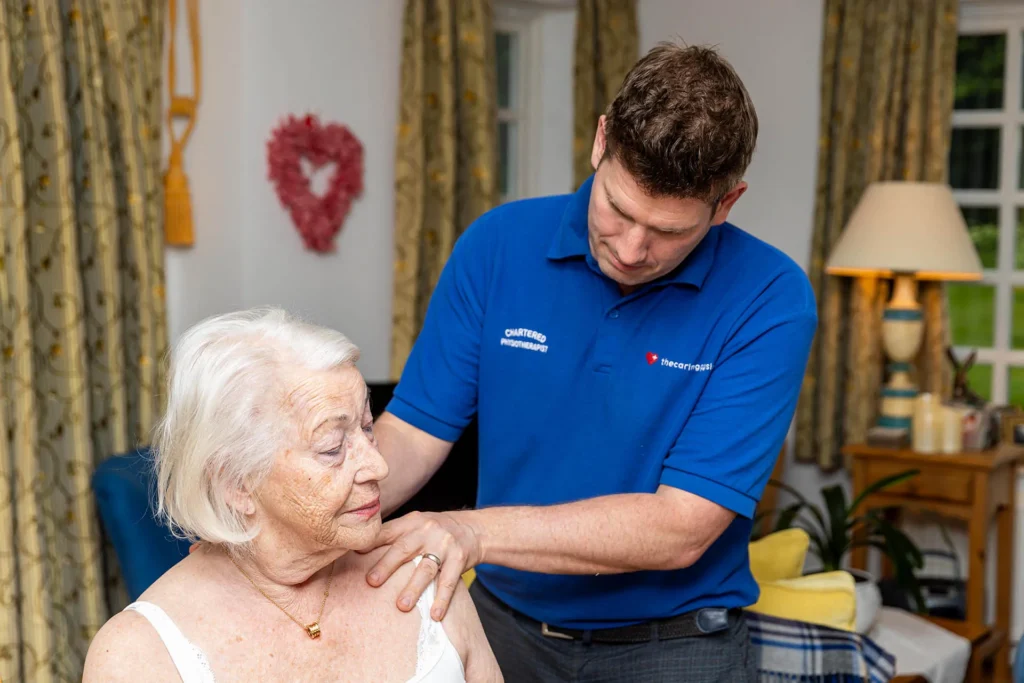
Your physiotherapy team in Camberley
George S. came to community work after orthopaedic, intensive care and respiratory posts in NHS and private hospitals, and was redeployed to an NHS community team during the pandemic. His focus now is muscles and joints: new hips and knees, fractures, and the stubborn back or shoulder that has stopped someone doing what they enjoy.
Grace M. has nearly fifteen years’ experience across acute hospitals, hospice and community services, with a particular interest in respiratory care, palliative care and long-term conditions. She builds every session around a goal the person has chosen.
Helen C. has been chartered since 2005 and covers Camberley alongside Woking, Guildford and Windsor. Years of trauma and orthopaedic work at St George’s and Northwick Park make her a natural fit for complicated recoveries — including case-managed clients who need a clear plan and clear reporting.
Hazel A. qualified as a physiotherapist in 2006 and works with us as a physiotherapy assistant, carrying on the programmes the physiotherapists set so that progress continues between their visits.




What people say about Helen, Grace and George
“I am a case manager and instructed The Caring Physio to review and treat my client at his home following surgery. Communication with Will and Helen was excellent throughout and they saw him quite quickly. They helped my client both mentally and physically.”
Georgie P., case manager
“Simone was delighted with Grace who helped her walking and climbing stairs and more importantly restored her confidence. Would certainly recommend.”
Simone M., walking and stairs after two broken legs
“Very professional and a positive experience. George one of the Physios motivated me to come out of a dark spot healthwise. Thank you.”
Antonella & Omar
Areas we cover in and around Camberley
Camberley
- Camberley town centre
- Old Dean
- Heatherside
- Crawley Hill
- Yorktown
- Watchetts
Frimley and the south
- Frimley
- Frimley Green
- Mytchett
- Deepcut
Bagshot and the heath
- Bagshot
- Lightwater
- Windlesham
Over the county line
- Sandhurst
- College Town
- Owlsmoor
- Crowthorne
- Blackwater
- Yateley
That takes in GU15, GU16, GU18, GU19 and GU20, with GU46 and GU47 across the Berkshire and Hampshire borders. If you are near Farnborough, Fleet or Ash, ring and ask.
We also visit families in nearby Bracknell, Woking and Guildford. See all the areas we cover.
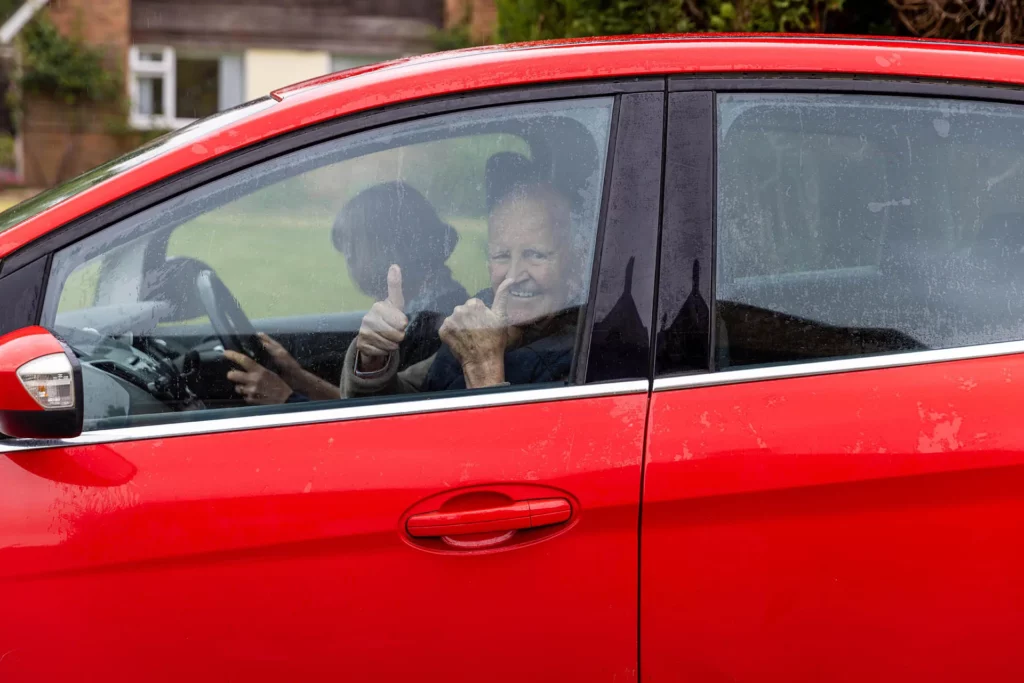
The things that matter in Camberley
The goals people bring us are never “improve hip strength”. They are small, specific and their own:
- Getting on and off the toilet without the frame or a hand to pull on
- Turning over in bed and getting up in the morning by yourself
- Hanging the washing out again
- Coffee in town with a friend, and the walk back to the car afterwards
- Getting down on the floor to play with the grandchildren — and back up again
- Feeling like yourself again, rather than like a patient
Each one is written down at the first visit and checked as we go, so you can see the change for yourself.
A hospital measures recovery in days. At home it is measured in stairs.
For most people in Camberley an emergency admission means Frimley Park Hospital. Stroke patients are cared for on the hyper-acute and acute stroke unit on ward G3, and some go on to rehabilitation on Runfold ward at Farnham Hospital. Planned hips and knees are often done privately at Spire Clare Park near Farnham. Wherever someone has been, the hard part tends to begin once the car has pulled away: the first night, the first bath, the first time down the stairs alone. That is where we come in.
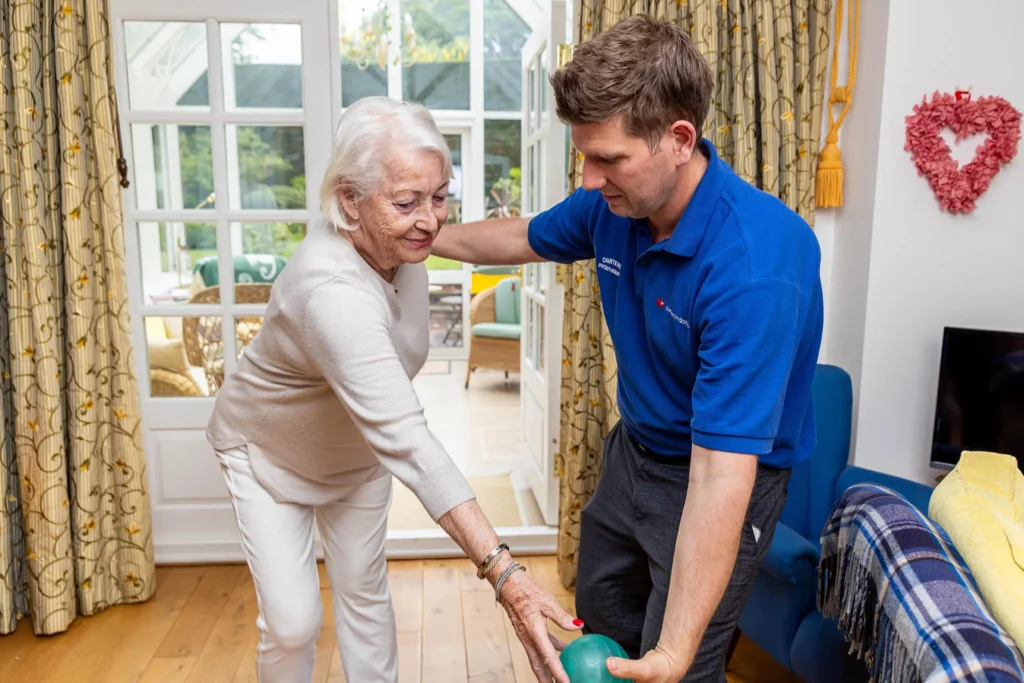
Most of a hospital stay is spent in bed
NHS England reports that many frail older people spend up to 83% of their time in hospital in bed and a further 12% in a chair, and that muscle wasting starts within 24 to 48 hours of admission. Muscle responds to the right work at any age, though, and starting rehabilitation in the first days home is the quickest way to win it back.
How we close the gap
As soon as you have a date
Ring us as soon as a discharge date is set and we will plan the first visit around it, so nobody spends the first week home wondering what to do next.
Carers working the same way
Where there is a care team, we show them the rehabilitation inside what they are already doing, so a transfer or a walk to the bathroom becomes part of the recovery rather than separate from it.
Round Frimley Lodge Park
Flat paths, open grass and benches along the way. A lap of the park on your own two feet is a goal plenty of people set — and reach.
For as long as it helps
We stay while the work is making a difference and say so plainly when it stops. What we are working to give back is strength, and with it some dignity.
Helping you recover using physiotherapy in the comfort of your home
FAQ - Your local questions
My husband is being discharged from Frimley Park and we are not ready. How quickly can you come?
Often within a few days, and sooner if you ring before he leaves rather than after. Frimley Park’s older people’s teams look after patients on the elderly care wards, and some go on to Heathlands Intermediate Care, and discharge can move faster than families expect once a bed is needed. There is no referral to chase and no waiting list — you contact us directly and we book around the date. The first week at home is when most ground is lost, so getting a visit into that week is worth more than a perfect plan that starts a fortnight later.
We can see my mother getting frailer. Nothing has happened yet. Is it too soon to ring?
It is the best possible time to ring, and almost nobody does. Frailty is not an inevitable part of ageing — that is the British Geriatrics Society’s own position, and they are clear that strengthening work can prevent and in some cases reverse it. Waiting for something to happen usually means waiting for a fall, a chest infection or an admission to Frimley Park, and every one of those costs weeks. If you can see her doing less than last year, gripping the bannister harder, taking the stairs one at a time, that is the moment the work is easiest.
My grandfather is 91. Is physiotherapy realistic at that age?
Yes, and age on its own tells us very little about what somebody can regain. The research is unambiguous that strength responds at any age — the Chartered Society of Physiotherapy built a whole public campaign on the fact that it is never too late to rebuild muscle. What matters far more than the number is what has changed recently and how quickly. Somebody of 91 who was walking to the shop in Camberley at Easter and is now not leaving the chair has a great deal to aim at. We would assess him properly and tell you honestly what we think is achievable.
My husband's Parkinson's is going to get worse. What is the point of physiotherapy?
The point is how well he lives on the way, and for how long. We are not going to tell you physiotherapy reverses Parkinson’s — it does not. What it does is hold onto function that would otherwise slip away quietly: the turn in the hallway, getting out of the chair without a run-up, the walk to the car without freezing at the door. Keeping something for another year is a real outcome, not a consolation prize. It also tends to mean less help needed rather than more, which matters at home in Frimley or Bagshot as much as it does clinically.
My mother did not get on with physiotherapy before and does not want to try again. Is it worth a visit?
Possibly, and it is worth one visit to find out. Plenty of people are wary of having someone new in the house, and that is understandable. We start with what she would like to be able to do again, even if that is only getting to her own front door in Lightwater. If she does not want us back after the first visit, that is a perfectly acceptable answer and we will say so to you plainly rather than keep turning up.
Can you visit my aunt in her care home in Camberley?
Yes, we visit care homes across Camberley, Frimley and Bagshot and we work alongside the home rather than around it. We ask the manager first, keep the staff informed, and fit around mealtimes and personal care. Families often come to us when somebody has been steadily doing less since moving in — not through any failing of the home, but because a place where everything is done for you is a place where strength quietly goes. Managers are welcome to contact us directly, and our fees are set out in full on our main FAQ page.
I live two hundred miles away. How will I know how he is getting on?
You will hear from us, without having to chase. Distance is common and it is one of the reasons families ring in the first place — the person who worries most is often the one who cannot see for themselves. We report after visits, we tell you what has changed and what has not, and we will say plainly if the work has stopped making a difference rather than quietly carrying on. You can ring us to ask, and you do not need to arrange it through whoever lives nearest. If something is going backwards, you will hear it from us first.
Local support in Camberley
As well as physiotherapy, families often need to know what else is out there. These are the organisations we are asked about most, and none of them charges for advice.
Surrey County Council adult social care — where an assessment of care needs starts.
Age UK Surrey — free local information and advice.
Action for Carers Surrey — for anyone looking after somebody, at any age.
Surrey Heath community transport — door-to-door transport for residents who find buses difficult, Monday to Friday: 01276 707655.
Care homes in Camberley
We visit residents in homes across Surrey Heath, from small independent houses to homes run by the national groups — among them Barchester’s Corrina Lodge on The Avenue and Bupa’s Collingwood Grange on Portsmouth Road.
Most of this work is arranged and paid for privately by families — a block of visits after a fall or a hospital stay, or ongoing work to keep someone moving. It sits alongside whatever the home already provides, and we work with their staff so the exercises carry on between our visits. You can read more about additional physiotherapy for residents.
Care home managers in Camberley — get in touch to discuss regular visiting physiotherapy for your residents.