
Home Visit Physiotherapy in Guildford
Get in touch today
If you have any questions or to see how we can help
Home physiotherapy across Guildford, from Merrow to Worplesdon
We provide home visit physiotherapy right across Guildford — from the streets below the cathedral to Merrow and Burpham, and out past the Hog’s Back to Wood Street and Normandy. Our chartered physiotherapists come to your house or your care home, so the work happens on your own stairs, in your own bathroom and on the path you actually use.
Families usually ring at one of four moments. A mother in Stoughton has stopped walking into town because the hill back up has started to worry her. A husband in Burpham is home from the Royal Surrey with a new knee, and the exercise sheet is not getting him up the stairs. A father with Parkinson’s is freezing in the doorway more often than he did last spring. Or a long spell of illness has left someone in a chair for most of the day, and nobody is quite sure what is still possible.
What matters to us is the person behind the phone call: what they used to do, what they have quietly given up, and what would make the week feel like their own again. We would always rather come before a fall than after one.
Our services in Guildford include:
- Older people’s physiotherapy — strength, balance and getting out of the house again without someone at your elbow.
- Dementia physiotherapy — keeping someone moving safely, at the time of day they are at their best.
- Post-operative rehabilitation — new hips and knees, fractures, and the weeks after a stay on the ward.
- Neurological physiotherapy — stroke, Parkinson’s and MS, worked on in the rooms where the difficulties actually show.
- Respiratory physiotherapy — breathlessness, COPD and the energy to get through the day.
- Muscle and joint pain — backs, shoulders and arthritic knees, assessed and treated at home.
- Care home physiotherapy — regular visits for residents, with staff shown how to carry the work on.
- Case management clients — rehabilitation after serious injury, with clear reports for the case manager.
Why families in Guildford come to us
Guildford is older than it looks. Behind the university and the commuter trains, the borough’s 143,600 residents include a growing share of older people: between the 2011 and 2021 censuses the proportion aged 65 and over rose from about 15.5% to 17.6%, and the over-85s grew fastest of all (ONS, Census 2021). Many live in houses built for the years when the stairs were nothing — split levels in Merrow, steep drives off the Epsom Road, cottages in Shere with a step at every door. That is where we work.
- Every physiotherapist who visits is chartered, HCPC registered and a CSP member. No exceptions.
- You ring us and we come. There is no clinic to get into and no queue to join.
- We are patient. Nobody is rushed, and nobody is made to feel they are taking too long.
- Visits people look forward to — an hour of good company as well as hard work.
- You will know what is happening. No jargon and no vagueness.
- We say when we have done what we can. You will not get visits that have stopped making a difference.
Before the first visit the office sends a short form, so we already know about the tablets, the falls and any recent stay in hospital when we knock on the door. That leaves the hour for the useful part: watching how your father gets out of his own chair, up his own stairs and into his own bath, and finding the one thing that is really holding him back. More often than not it is confidence rather than strength. Treatment starts in that first session, and we agree a plan around a goal he has chosen — with whoever is at home shown how to keep it going between visits.
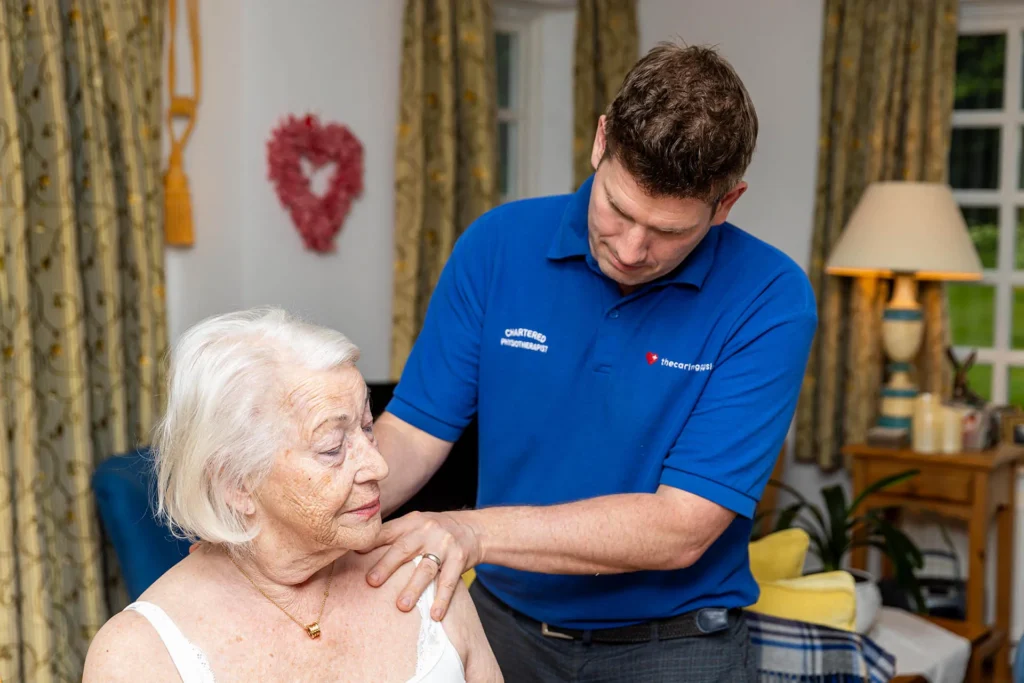
Your physiotherapists in Guildford
Helen C. has been chartered since 2005 and covers Guildford alongside Woking, Camberley and Windsor. Her background is orthopaedic — trauma work at St George’s and Northwick Park, then outpatients and clinical leadership at Ashford and St Peter’s — so new joints, fractures and the long recoveries that follow a run of operations are familiar ground. Families tend to mention her patience, and how clearly she explains what she is doing and why.
Natalie W. spent most of the last decade in NHS community teams, much of it on rapid response, helping people stay at home when they were close to going into hospital. She is a qualified postural stability instructor — the strength and balance programme built for preventing falls — and ran breathlessness and fatigue groups at a hospice, which makes her a natural fit for COPD and long-term conditions.
Lucy W. brings wide NHS experience across orthopaedics, neurology, respiratory and intermediate care, with a particular interest in orthopaedic rehabilitation. She played hockey for England and Great Britain, so she knows how much of recovery is steady training — and how to pitch it for an eighty-five-year-old rather than an athlete.



What families say about our physiotherapists
“My mother suffered a stroke and needs regular physio therapy, she had been seeing Helen for about a year now and I cannot rate her highly enough. She has been so wonderful for my mum. She genuinely cares about her clients and goes out of her way to help in any way.”
Ski C., stroke rehabilitation for her mother
“Helen has gone above and beyond to help us. Helen is a credit to the company … It is a pleasure to deal with people who actually really care about their patients.”
Piera R., family of a patient
“Ann was very pleased for Natalie to come and help with physiotherapy.”
Tom C., about Natalie
Areas we cover in and around Guildford
Guildford and the inner suburbs
- Guildford town centre
- Stoughton
- Bellfields
- Park Barn
- Westborough
- Onslow Village
- Guildford Park
- Charlotteville
East towards the Downs
- Merrow
- Burpham
- Boxgrove
- Jacobs Well
- West Clandon
- East Clandon
- Shere and Gomshall
- Chilworth and Albury
West and south
- Worplesdon
- Fairlands
- Wood Street Village
- Normandy
- Puttenham
- Compton
- Shalford
- Wonersh and Bramley
That takes in most of GU1, GU2 and GU4, with the GU3 and GU5 villages beyond. If you are near the edges — Ash, Send or Godalming — ring and ask; colleagues covering Woking and Godalming visit the neighbouring patches.
We also visit families in nearby Woking, Godalming and Camberley. See all the areas we cover.

What people in Guildford want back
Ask someone what they want from physiotherapy and they rarely say better balance. They name something they used to do without thinking:
- Getting in and out of the bath or shower without someone waiting outside the door
- Putting on your own socks and shoes in the morning
- Doing your own shopping — the Friary, or the farmers’ market on the High Street — at your own speed
- Getting back to church, the club or the U3A talk you have been missing
- Walking the dog again, even if the loop is shorter than it was
- A night’s sleep without lying awake planning for the next fall
We write the goal down at the first visit and check it against what has changed, so progress is something you can see rather than take on trust.
The Royal Surrey's work ends at the front door. Ours starts there.
For most people in Guildford a broken hip or a planned joint replacement means the Royal Surrey County Hospital, where orthopaedic patients — planned and emergency — are cared for on Bramshott Ward. Planned hips and knees are also done privately at Mount Alvernia on Harvey Road. The ward’s job is to get someone well enough to go home. What comes next is a different job: the first night, the first trip to the bathroom, the first time the stairs are tackled with nobody in a uniform nearby. That is the part we are here for.
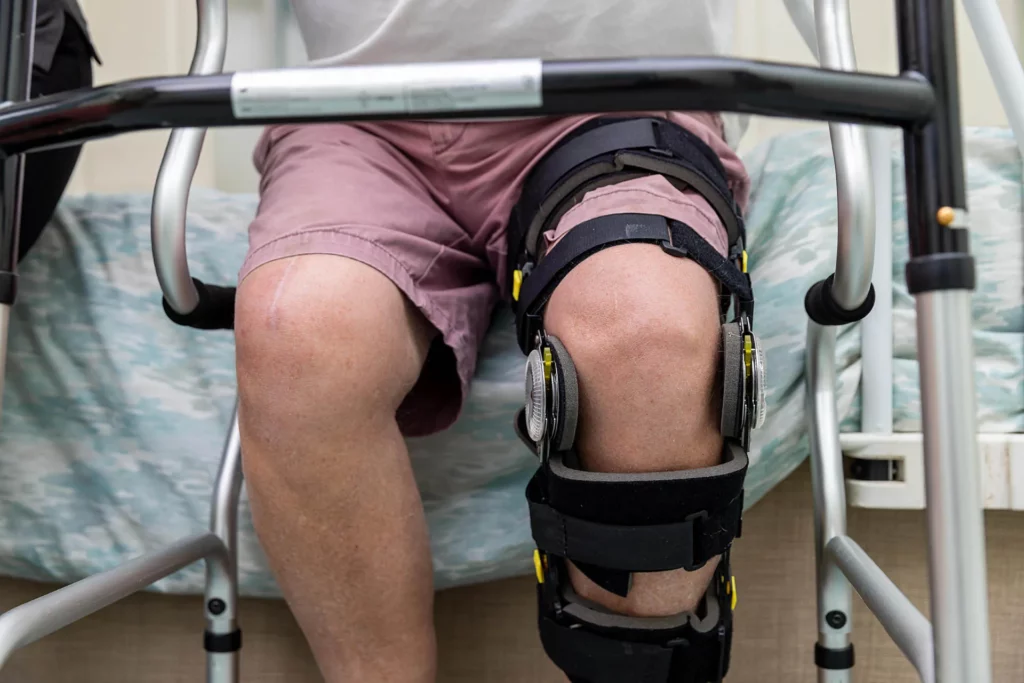
Walking is the first thing a ward takes
The British Geriatrics Society reports that up to 65% of older adults in hospital lose some of their ability to walk, and that between 30% and 55% find washing, dressing or getting to the toilet harder by the time they leave. It is not one-way. Strength and walking respond to the right exercise at any age, and the sooner it starts after discharge, the more of it comes back.
British Geriatrics Society — Sit up, get dressed and keep moving
How we close the gap
As soon as you have a date
Ring us with the discharge date and we will book the first visit around it. The first week home is when confidence is easiest to lose and quickest to rebuild.
The right exercises, done with you
Not a sheet of diagrams left on the table. We do them with you, correct them as you go, and change them as you improve.
Up to the Castle Grounds
The gardens below Guildford Castle are a short walk from the High Street and a good first goal: there and back on your own two feet, with a bench halfway if you want it.
Less help needed, not more
As you do more for yourself, the care package often shrinks with it: fewer calls, or one carer where there used to be two.
Helping you recover using physiotherapy in the comfort of your home
FAQ - Your local questions
Can you help my mother come home from the Royal Surrey?
Yes, and the sooner you ring the better. We visit across Guildford and take referrals directly from families, so nothing has to go through the ward. If she has been on Elstead Ward, the orthogeriatric and frailty unit, she has probably had good work done on standing and walking a few steps — the gap is usually between that and managing her own stairs at home. Tell us the discharge date when you have it and we will plan the first visit around the first few days back, which is when confidence slips fastest.
My father had his stroke five months ago. I hear the first three months matter most — is it too late for him now?
The premise is right and we will not pretend otherwise: the first three months after a stroke are usually the most productive. But NICE guidance is explicit that rehabilitation should continue for as long as it helps someone reach their goals, and it asks for a review at six months and then yearly — which only makes sense because later progress happens. It tends to be slower and more specific: one transfer done more safely, one walk done without stopping. If he came through Frensham Ward at the Royal Surrey, that team will have set goals we can pick up and carry on.
My mother manages inside the house but has not been out since the winter. Is that something you help with?
Yes, and it is one of the best reasons to ring. Nothing has happened, nobody has been admitted, and that is exactly the point — this is the stage where the work is easiest and the gains are biggest. What usually keeps someone in is not their legs but the kerb, the car door and the fear of being caught out. We practise the real route, not a corridor: her own front step, the slope down to the road, the walk to where the car actually parks. The best time to ring is before the fall, not after it.
My aunt is very anxious and has lost all her confidence. How would you handle that?
Gently, and slowly, because confidence is a clinical problem rather than a personality one. Most people can do considerably more than they believe, and a great deal of our work is proving it to them in steps small enough not to frighten anybody. We do not arrive with a programme and push her through it. The first visit is mostly finding out what she has stopped doing and why, and picking one thing she would like back. Company and conversation are part of the treatment, not a nicety alongside it.
My husband has dementia and forgets the exercises as soon as you leave. Is there any point?
Yes, and it is one of the most common worries we hear. With dementia, exercises rarely happen because someone remembers them. They happen because they are built into the day. We tie them to things that already happen, such as standing tall after breakfast, a few steps to the window before the news, or sit-to-stands while the kettle boils. We also show you or the carers how to prompt without it feeling like a test. Progress can be slower and some days will not count, but strength and balance still respond, and we will tell you honestly whether it is working.
My brother lives with Dad in Burpham and does everything for him. Could that be holding Dad back?
Possibly, and it is a good question to ask. When someone we love is struggling, the natural thing is to do it for them: the tea, the dressing, the hand under the arm on the stairs. Done every day, that kindness can quietly remove the practice that keeps muscles and confidence going. We look at a normal day with both of them, find the jobs your father can still manage with a little more time or the right chair, and show your brother how to help without taking over. It usually takes some pressure off him too.
My father-in-law is in a care home and they say they already do physiotherapy. How is this different?
Most homes in Guildford do good work keeping people moving, and we are not a replacement for it. The difference is time and specificity. We come for a full session with one person and one set of goals — getting off that particular chair, managing that particular corridor — rather than fitting movement around a shift. We also show the care team what we are working on so the progress carries on between our visits, which is where most of the gain actually happens. Homes often ring us themselves for exactly this reason, and we are happy to talk to the manager directly.
Local support in Guildford
As well as physiotherapy, families often need to know what else is out there. These are the organisations we are asked about most, and none of them charges for advice.
Surrey County Council adult social care — where an assessment of care needs starts.
Age UK Surrey — free local information and advice.
Action for Carers Surrey — for anyone looking after somebody, at any age.
Guildford Borough Council community transport — door-to-door transport for borough residents with a mobility problem or ill health: 01483 458055.
Care homes in Guildford
We see residents in homes across the borough, from small independent houses to homes run by the national groups — among them Barchester’s Worplesdon View on Worplesdon Road and Silverbirch House at Tovey Green.
Most of this work is arranged and paid for privately by families — a block of visits after a fall or a hospital stay, or ongoing work to keep someone moving. It sits alongside whatever the home already provides, and we work with their staff so the exercises carry on between our visits. You can read more about additional physiotherapy for residents.
Care home managers in Guildford — get in touch to discuss regular visiting physiotherapy for your residents.