
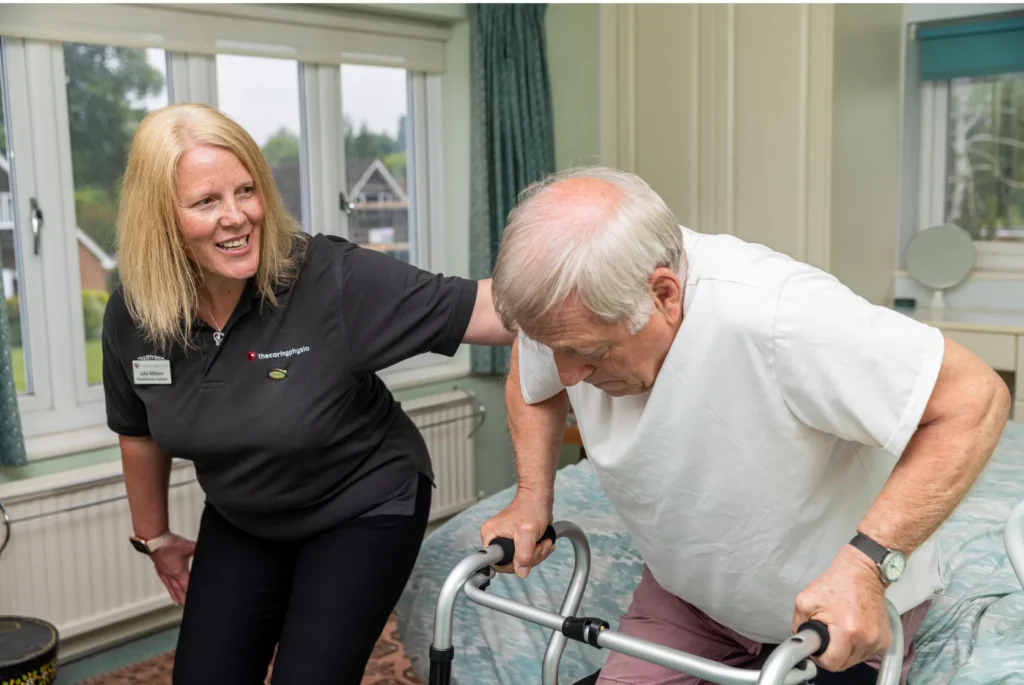
“We’ll have to put a hospital bed downstairs and convert your living room into a temporary bedroom.”
Families hear that sentence in a hospital, usually from someone kind, usually while they are still taking in the news about the fracture. It sounds like a practical arrangement. Nobody in that conversation says the word rehabilitation, because that is a conversation for later.
The bed arrives. It is the sensible thing to do — the stairs are impossible, and the alternative is not going home at all. But it is also the moment a temporary problem starts to look permanent. Everything that would rebuild your mother’s strength is now on the other side of a staircase she is not using.
Families tell us the hospital fixed the hip but sent home a different person. They are not wrong. And it is not a criticism of the hospital — something real happens to a body that stops moving, and it happens much faster than most people expect.
Who we see
We are a national home-visit physiotherapy service for older people. Our physiotherapists are all chartered, and we visit people in their own homes across much of England — you can find out more about the areas we cover. Those visits happen everywhere from Berwick-upon-Tweed down to Portsmouth, and the pattern is almost exactly the same in all of them.
Most weeks, the people we meet look something like this. Someone in their eighties who has had a fall and a fractured hip. Someone home after a stroke, managing a bit better each week but nowhere near where they were. Someone with Parkinson’s whose walking has quietly got worse over a year. Someone living with dementia who has stopped standing up on their own, and a daughter who does not know whether that is the dementia or something else. Someone who came out of hospital on four care calls a day, with two carers at each one.
What almost all of them have in common is that they are not the average patient. And that matters more than it sounds, because most of the reassuring statistics about recovery are averages.
What happens to strength in hospital
There is a study that gets quoted a lot, and it is worth knowing what it actually found.
Researchers took healthy older volunteers — average age sixty-seven, no illness, eating normally — and put them on ten days of complete bed rest. Ten days.
In that time they lost around 13% of the strength in their thigh muscles. They lost about a kilogram of muscle, most of it from the legs. And their bodies more or less stopped building new muscle while they lay there.
Now remember who those volunteers were. Healthy. Well fed. No infection, no pain, no operation, no anaesthetic. That was the best case. Your mother had none of those advantages.
There is something else that happens, and it explains a lot of what families notice. Bed rest does not just shrink muscle — it weakens the connection between the nerve and the muscle. That is why someone can look exactly the same as before and yet be visibly weaker. The muscle is still there. The message is not getting through as well.
About “ten days in bed ages you ten years”
You may have seen this on a poster on a ward. It comes from a good campaign and the point it is making is right. But since we are being straight with you: nobody actually measured ten years.
It is a comparison, not a measurement. Someone took the muscle lost in ten days of bed rest and worked out how many years of normal ageing that would be equal to. Depending which figures you use, the answer lands somewhere between about four and thirteen years. Ten is a sensible middle.
You will also see it said as “in the over-eighties”. That was added later — the volunteers in the study averaged sixty-seven.
None of this makes the message wrong. Bed rest really does take a serious toll, and it really is worse the older you are. We mention it because we would rather explain a number than repeat one, and because families get told a lot of things in a short space of time.
The figure that changed how we work
Here is one we think about often. In one study of older hospital patients, around 60% of those who were lying in bed had no medical reason to be there.
Most of the time, being stuck in bed in hospital is not about being too ill to move. It is about waiting. Waiting for a review, waiting for equipment, waiting for someone who has time to walk alongside you.
Which means most of this weakness is not an unavoidable part of being ill. It can be prevented. And once it has happened, it can be reversed.
Why our patients are not the average
About one in eight people who leave an English hospital go back in as an emergency within a month. That sounds manageable, and for most people it is.
But that figure includes everyone. It includes the fifty-five-year-old who came in for a planned knee replacement and walked out four days later. Averages are made up of very different people.
The NHS has its own way of working out who is most at risk, based on things like how many times someone has been in hospital before, how many long-term conditions they have, and how long this stay lasted. Among the small group it flags as highest risk, close to six in ten went back in within a month.
To be fair to the numbers: that model is narrow, and “highest risk” is a score rather than a description of a person. But the pattern is not in doubt. The further someone is from being a healthy, straightforward case, the less that comforting one-in-eight has to do with them.
And that is the group we visit. Not exclusively — but the person with dementia, the fractured hip, the two carers and the hoist, the third admission this year. When a family tells us “the hospital said she should be fine”, we understand why they were told that, and we also know the average was never really about her.
What we actually do about it
Back to the bed in the dining room. It looks much the same wherever we are — a second-floor flat in Kensington, a village outside Cambridge, a house partway up a hill in Godalming.
It starts with strength, because nothing else is possible without it. Standing up from the chair she actually sits in, over and over, until standing up stops being an event. We use big movements that work several muscle groups at once, because that is how a body works in a house — nobody climbs the stairs one muscle at a time.
Then confidence. This is not a personality issue, it is part of the injury. After a fall, and especially after the confusion that often follows an operation, people become frightened of the thing that hurt them. That fear is completely reasonable, and it is also the main reason people stop moving. The only thing that fixes it is doing the thing, safely, with someone next to you.
Then the practical goals, roughly in this order. Walking with the frame, and then without it. Getting in and out of a normal bed instead of a hospital bed. Getting to the toilet at night on your own — the goal families rarely mention first and almost always care about most. And the stairs. Practised as actual stairs, in the actual house, not as an exercise that vaguely resembles stairs.
Somewhere along the way, the hospital bed goes back and the bedroom goes back upstairs. That is usually the point where a family stops thinking of it as an illness and starts thinking of it as a recovery.
What you can do before we get there
Families often ask what they should be doing while they wait for an assessment. The honest answer is: quite a lot, and none of it is complicated.
Two things first. If your relative is in pain, unwell, dizzy, or has just had surgery, check with the ward or the GP before starting anything. And nothing below should be done alone — you are there to steady them, not to test them.
Two things worth checking
Sitting in a chair, can she straighten one leg out in front and hold it there for ten seconds? Then the other. It sounds simple, and that is the point — it needs no equipment, it is done sitting down, and it tells you something real. Holding the knee straight uses the same muscle that gets you out of a chair. If she can manage ten seconds on each side, there is enough power there to work with. If the leg drops after two or three seconds, or one side is clearly weaker than the other, that is worth mentioning to whoever assesses her.
How long is she sitting? Not how long she says — how long she actually is. Over one afternoon, notice how often she gets up. Someone who moves once in five hours is losing strength every day, at home as much as in hospital. Getting up roughly every hour, even briefly, even just to stand, changes that.
A simple exercise you can do together
If she can stand safely, this is the one we would give you.
Try this together
Set the chair directly behind her, so that if she tires she is already in the right place to sit down. Put the frame or a stable surface in front. Then ask her to stand up, get into her best upright posture — head up, shoulders back, weight through both feet — and simply hold it.
Count out loud. Can she manage ten seconds? Twenty? Make it a challenge rather than a chore, because that is what makes people try. Then sit, rest properly, and go again. Three rounds is a good session.
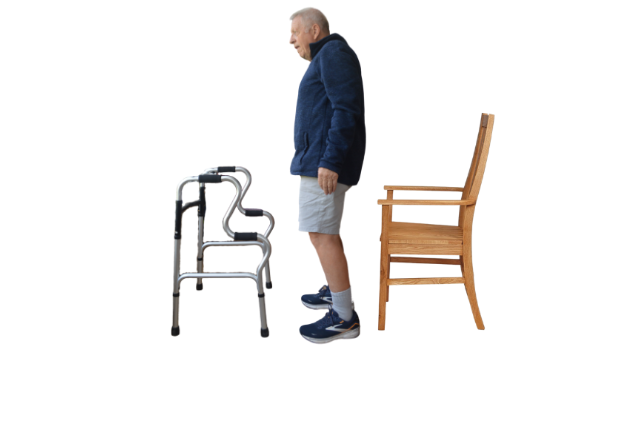
The illustration above comes from our own home exercise app. We built it ourselves, because the exercise programmes available to us were written for gyms and clinics — young models, benches, equipment nobody has. Ours is drawn from the houses we actually visit: a dining chair, a frame, a kitchen worktop, a bannister. Every physiotherapist on our team can build a programme from it in a few minutes and leave it with the family, so the exercises carry on between visits rather than being forgotten by Tuesday.
Standing endurance is one of the safest ways to rebuild strength. Nothing has to be lifted, nothing has to be balanced on one leg, and the chair is right there. Yet it works the legs, the trunk and the postural muscles at the same time, and it is the foundation of everything else — walking, stairs, getting to the toilet at night.
Do it while you are there, not as homework. Your presence is the safety measure.
What to do on every visit
If you visit in hospital, or you are at home with her:
- Get her out of bed and into a chair. Sitting up in a chair is meaningfully different from sitting up in bed. Ask the nurse whether it is safe, then do it.
- Get her dressed in her own clothes. It sounds cosmetic. It is not — people in pyjamas behave like patients, and people in their own trousers behave like themselves.
- Walk to the toilet rather than using the commode, if the staff say it is safe. Every walk counts, and this is the one that keeps dignity attached to the effort.
- Ask, every single day, what she has done today. Not how she is feeling. What she has actually done, and how far she walked.
What not to do
The instinct when someone is frail is to do things for them. Carry the cup, fetch the cardigan, bring the meal over. It comes from love and it is completely understandable.
But every task you take over is a repetition she does not do. If she can get her own cup of tea, slowly and awkwardly, let her — and stay in the room while she does. Helping less, on purpose, while staying close, is usually the most useful thing a family can do.
And do not let anyone tell you she should rest until she feels stronger. It does not work that way round. Strength comes first, and the feeling follows it.
If you are reading this about someone you love
Weakness after a hospital stay is normal, it is very common, and most of it can be reversed. It is not the beginning of the end, and it does not mean your mother has suddenly become old.
But it will not sort itself out. Resting more makes it worse, not better. Strength only comes back when the body is asked to do something, again and again, just slightly beyond what it can comfortably manage today.
The right time is when someone is home, safe, and has stopped improving — not six months later, when everyone has got used to the bed being downstairs.
We visit at home, we work on the things that actually matter in that house, and you do not need a GP referral or a place on a waiting list. If your town is one we already cover, the page for it will tell you which hospital we usually pick people up from and who visits. If you are not sure whether it would help, give us a call and we will tell you honestly either way.
Common questions
How quickly does someone lose strength in hospital?
Faster than almost anyone expects, and fastest in the people who can least afford it. Research by Kortebein and colleagues found that healthy adults averaging 67 years old lost 1.5kg of whole-body lean mass and nearly a kilogram from their legs after just ten days of bed rest — more than 38-year-olds lost in twenty-eight days. Somebody who is already unwell, already frail, and eating less will lose it faster still.
Is the weakness after a hospital stay permanent?
Mostly, no. Deconditioning is one of the most reversible things that happens to older people, and that is the single most important thing to understand about it. But it does not reverse on its own. Resting more makes it worse. Strength only comes back when the body is asked to do something, repeatedly, slightly beyond what it can comfortably manage today.
When is the right time to start rehabilitation after a discharge?
The first fortnight home is when most ground is lost, so the answer is usually “now”. Not six months later, when everybody has got used to the bed being downstairs. If somebody is home, safe and has stopped improving, that is the moment — and it is worth ringing before the discharge rather than after, so the first visit can be booked into that first week.
Do we need a GP referral to arrange private physiotherapy at home?
No. We are chartered physiotherapists and families can contact us directly — no GP letter, no waiting list. With permission we will write to the GP if we find something that needs a doctor, and we are glad to report progress if the practice wants it. Nothing has to be arranged through the surgery first.
Sources
Kortebein P et al. Effect of 10 days of bed rest on skeletal muscle in healthy older adults (2007, 2008). · Graf C. Functional decline in hospitalized older adults. American Journal of Nursing, 2006. · Billings J et al. Development of a predictive model to identify inpatients at risk of re-admission within 30 days of discharge (PARR-30). BMJ Open, 2012.
Written by

Chartered Physiotherapist · Clinical Director, The Caring Physio
Will founded The Caring Physio to do rehabilitation where it actually matters — on the stairs, in the bathroom, in the house someone lives in. Read his full profile.