
Home Visit Physiotherapy in Berwick-upon-Tweed
Get in touch today
If you have any questions or to see how we can help
Physiotherapy at home in Berwick-upon-Tweed and the surrounding villages
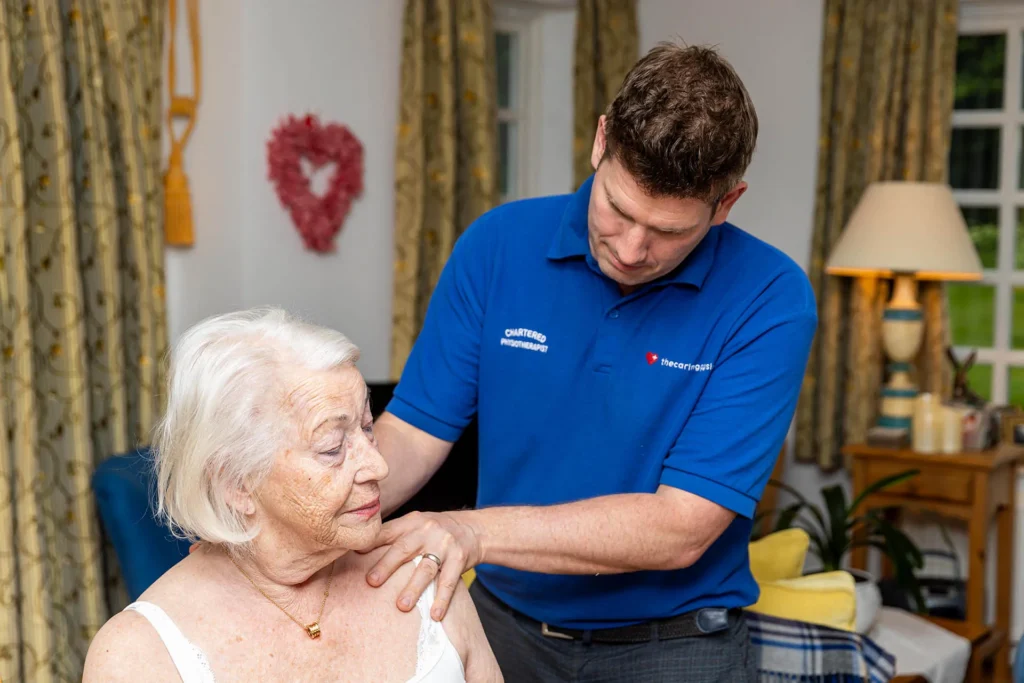
We provide home-visit physiotherapy across Berwick-upon-Tweed and north Northumberland, because a long drive to a clinic undoes much of what the appointment was for. A chartered physiotherapist comes to your door, at home or in a care home. No referral is needed, and we run no waiting list of our own.
Calls from up here come later than they should, because everything is further away. Somebody home from Berwick Infirmary’s orthopaedic beds after a fracture. Somebody in a care home who has stopped standing and is hoisted. Somebody with dementia whose walking has slipped faster than the family expected. Or nobody has been anywhere at all, and a son in Newcastle can hear down the phone that things are slipping. Being lifted from a chair you once rose from on your own takes something away that matters. It is worth ringing before it gets that far. Weakness can turn into a fall, and too little movement into dehydration or a chest infection, and by the time the GP visits an ambulance may be the only option left.
Our services in Berwick-upon-Tweed include:
- Older people’s physiotherapy — steadier walking indoors and out, so a quiet afternoon on your own feels safe again.
- Dementia physiotherapy — keeping walking and transfers going for as long as they can be.
- Post-operative rehabilitation — rebuilding after a new hip or knee from Wansbeck General Hospital or Nuffield Health Newcastle Hospital, without the long drive back for appointments.
- Neurological physiotherapy — stroke, Parkinson’s and MS, worked on at home rather than sixty miles away.
- Respiratory physiotherapy — for COPD, breathlessness and recovery after a chest infection.
- Muscle and joint pain — aching joints, a stiff back or a fracture slow to settle, treated in your own house.
- Care home physiotherapy — regular visits to residents in homes across north Northumberland.
- Rehabilitation for case management clients — long-term and complex post-surgical rehabilitation, coordinated with the case manager.
- Live-in rehabilitation care — a live-in carer who keeps the rehabilitation going every day, which matters where visits mean long drives.
Why families in Berwick-upon-Tweed come to us
The north of Northumberland is thinly populated and a long way from everything, and that is exactly what makes a small loss of function serious here. In Berwick, Tweedmouth and Spittal people manage; out at Belford, Bamburgh or a house beyond Longframlington, giving up driving and giving up independence are close to the same thing. We are usually rung after a fall, or when somebody home from hospital finds that the ward’s walking frame does not fit their own hallway.
- Every visit is by a chartered physiotherapist, HCPC registered and a CSP member.
- Ring us directly: there is no referral to chase and no clinic to reach.
- If the usual approach will not suit your house, we work out one that does.
- Visits that are hard work and good company in equal measure.
- Plain English throughout, so you always know what is happening and why.
- Told it will not get better? We will look for ourselves and say honestly what we see.
An assessment that is only talking is an hour nobody should be charged for. A form sent out in advance means the physiotherapist arrives already knowing the history — which matters more here, where a wasted visit is a wasted drive too. The hour goes on finding what is really in the way, agreeing what she most wants back, and getting some treatment and the first exercises done. Gentler than the sessions that follow, but never just a conversation.
Berwick, the north coast and Alnwick: where we visit
Berwick and the Tweed
- Berwick-upon-Tweed town centre
- Tweedmouth
- Spittal
- Norham
- Scremerston
The north coast
- Belford
- Bamburgh
- Seahouses
- Beadnell
- Craster
- Wooler
Alnwick and the coast south
- Alnwick
- Alnmouth
- Amble
- Warkworth
- Felton
- Shilbottle
- Longframlington
That covers most of TD15, NE66, NE65, NE68, NE70 and NE71. Pippa looks after north Northumberland for our team. Across the border towards Coldstream or Kelso, or inland towards Rothbury? Ask us, and we will say honestly whether we can come regularly.
What matters most to families up here
Berwick Infirmary does the part that has to happen in a hospital. The rest happens at home, and it happens on the particular things that have slipped away without anybody deciding they should — one step, one chair, one walk to the door.
- Climbing the stairs to bed instead of camping in the front room.
- Managing a shower again, rather than a strip wash at the sink with somebody waiting outside the door.
- Getting the washing in and out of the machine.
- Getting in and out of a car — which this far north is the difference between keeping an appointment and cancelling it.
- Walking along to a neighbour’s on the Spittal front rather than waiting for a knock.
- Feeling useful rather than only looked after.
Small as they sound, each one matters. Each is the difference between a day that needs somebody else in it and one that does not, and we work with the family and the care team so what is gained stays gained. As independence returns the care usually reduces — fewer calls, or one carer instead of two. Carers in this part of the county spend a good share of the day driving, so an hour less help needed in the morning is worth more here than it is in a town.
The ambulance goes sixty miles south. The recovery happens in your own hallway.
Berwick Infirmary does more than its size suggests: inpatient beds for elderly medicine, orthopaedic rehabilitation and palliative care, intermediate care, a day hospital with ambulatory care, physiotherapy, occupational therapy and a GP-supported urgent treatment centre. What it does not have is an emergency department, so serious admissions travel — south to the specialist emergency care hospital at Cramlington, west to Borders General at Melrose, or to Newcastle for more complex care. Northumbria Healthcare runs a free daily car service for relatives visiting from Berwick, which tells you most of what you need to know about the distances families here cover.
That is the part we take on. Tell us the discharge date and we will usually be there within a few days, because the fortnight after somebody gets home is worth more than any month later on.
Where 1,000 older people would have 850 falls in a year, exercise means about 195 fewer.
That comes from a Cochrane review of 108 trials and more than 23,000 people living at home, which found exercise cuts the rate of falls by around a quarter. Strength and balance work, done regularly, is what changes what happens next.
How we close the gap
As soon as you have a date
Ring us with the discharge date and we book the first visit around it.
Rehab on your own front step
The stairs, the bathroom and the path you actually use, rather than a gym or a ward corridor.
Helped, not taken over
Help given out of love can end up doing what a person could still do. We show the family and carers how to support without taking over, so independence grows back.
Confidence comes back too
People are usually capable of more than they think. Much of our job is showing them, one small win after another, and good company helps more than you would expect.
Your Berwick physiotherapist
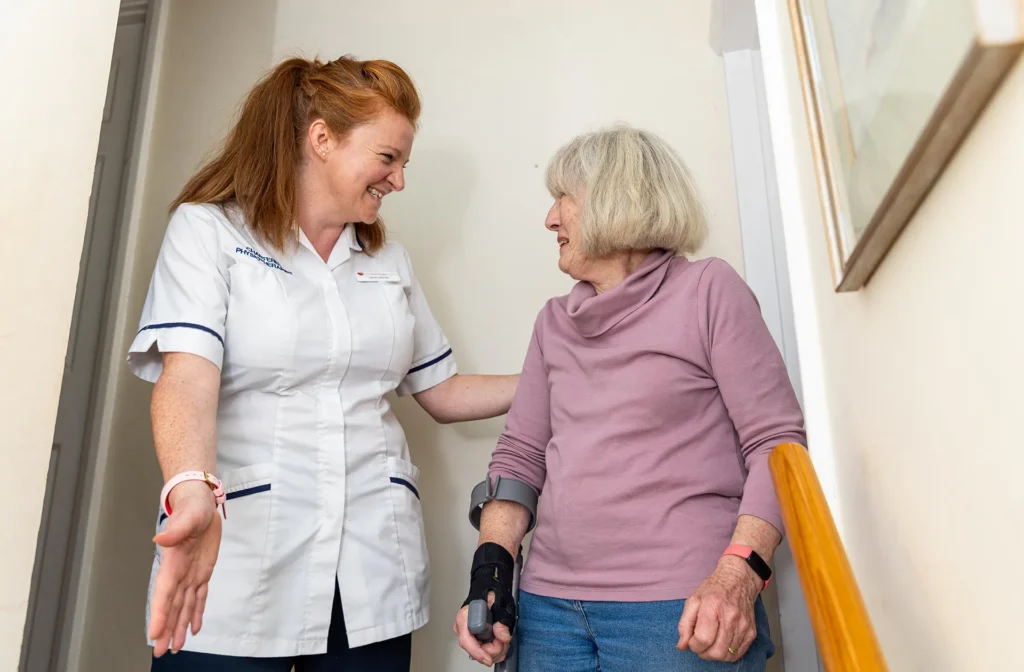
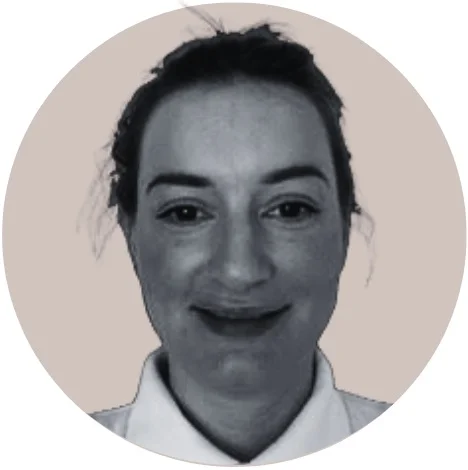
Pippa covers Berwick-upon-Tweed and north Northumberland. Her NHS background spans acute frailty, falls and stroke rehabilitation, and she plans every visit around what matters to you, whether that is a walk on the town walls or managing the stairs at home.
Explore our physiotherapy services in Berwick-upon-Tweed
FAQ - Your local questions
My mother is on a ward at Berwick Infirmary. Do you liaise with the hospital team before she comes home?
Yes, provided she is happy for us to. Berwick Infirmary looks after elderly medicine, orthopaedic rehabilitation and palliative care, so plenty of people recover there, though an emergency may have begun at Cramlington or Borders General. Ahead of her return we phone the discharge team and hear from the ward nurses and therapists about her care plan and what is in place at home, from carers to community physiotherapy. Her first visit is then booked for her first days home, and if community physiotherapy is delayed we cover the interval and then work with them.
Grandad walked into hospital and has come home needing a hoist. Can that be undone?
Often partly, and families ask us this a great deal. Going in walking and coming home needing a hoist usually means strength lost lying down rather than a new injury — in one study even healthy volunteers lost about 14% of their stair-climbing power after ten days of bed rest. What goes that way can usually be worked back, though it returns more slowly than it went. We would not promise he will come off the hoist; nobody honest would. What we can offer is time to rebuild strength and confidence, with the equipment changed as he needs less of it, and standing on his own legs as the goal.
My dad says he does not want any more physio. Can you talk to him?
Yes, and we would far rather have that conversation than turn up to a closed door. People who say they have had enough of physiotherapy usually mean they have had enough of exercises that did not connect to anything they cared about. So we start from what he wants back — getting out along the front at Spittal, getting into a car, being left on his own for an afternoon — rather than a standard programme. The first call is with a physiotherapist, not a booking line, and nothing is committed to on it. If after the assessment he still does not want to, that is his call.
My mother is my father’s carer and she is exhausted. Does this help her too?
Yes, very often. When one person is doing all the lifting, the prompting and the worrying, anything that reduces what your father needs day to day comes straight off your mother’s week — a transfer she no longer has to help with, a night she is not woken, a morning she gets back. We also show her how to do the parts she still has to do in a way that costs her less. Carers Northumberland is worth a call in its own right: it supports unpaid carers with advice, advocacy and groups across the county.
We are not in Berwick itself — is it worth ringing anyway?
Almost certainly. Our cover here runs a long way beyond the town: Tweedmouth, Spittal, Norham and Scremerston around Berwick, down the coast through Belford, Bamburgh, Seahouses, Beadnell and Craster, inland to Wooler, and south to Alnwick, Alnmouth, Warkworth and Amble. Further afield, towards Coldstream, Kelso or Rothbury, a quick call will tell you whether we can reach you.
Is there private home physiotherapy in Berwick-upon-Tweed without a GP or hospital referral?
No referral is needed — you ring us directly and we arrange the first visit. Nobody needs to refer you, and we keep no waiting list, because the physiotherapist drives to your house rather than you to a clinic. That matters more here than almost anywhere, where getting to an outpatient appointment at Alnwick or further south can take most of a day and undo a fair part of what the appointment achieved. If you are already under a team at Berwick Infirmary we work alongside them, not instead of them. For fees and payment, see the main FAQ page.
My grandmother has started holding on to the furniture to get round her cottage in Tweedmouth. Should we ring now or wait?
Ring now. Holding on to furniture to get about usually means balance or leg strength has started to slip, and that is far easier to work on before a fall than after one. We would visit her in Tweedmouth, see which rooms and steps worry her, and set a few simple exercises she can do every day, alongside small changes to the house that make getting about safer. You can call us yourself; she does not need a GP referral. Pippa covers Berwick, Tweedmouth and Spittal regularly, so fitting in a first visit is rarely difficult.
Local support in Berwick-upon-Tweed
Up here, knowing who else can help matters as much as the physiotherapy. These are the services families in north Northumberland use most.
Age UK Northumberland — information, advice and advocacy for older people anywhere in the county, along with care at home, befriending and a Friendship Line, run from Ashington.
Alzheimer’s Society Dementia Adviser, North Northumberland — advice and information for people with dementia, their carers, family and friends, face to face, by telephone, email or post, on 01670 813255.
HospiceCare North Northumberland — wellbeing centres in Alnwick and Berwick serving around 65,000 people, with hospice at home, family and bereavement support, a dementia support service and therapeutic drop-in cafés, free at the point of need and open to self-referral.
Onecall, Northumberland County Council adult social care — phone 01670 536400 around the clock to ask for a care assessment, equipment or care at home. Families often combine council help with private physiotherapy.
Care homes in Berwick-upon-Tweed
Homes in this part of the county are mostly small and independently run — Garden House at Spittal, and Castleview on Howling Lane and Abbeyfield House in Alnwick among them. Current ratings are on the CQC register, since the county council does not publish a directory. Wherever your relative is, we can come.
Families arrange and pay for this privately, and we plan visits in runs along the coast so they stay regular. We work with the home’s staff so the practice continues on the days in between. Read about visiting physiotherapy for care home residents.
Care homes in Berwick, Alnwick and along the coast: we would be glad to talk about regular visits for your residents.
Berwick-upon-Tweed is as far north as our visits go. Sixty miles south you will find home physiotherapy in Morpeth and home visit physiotherapy in Blyth. Every area we cover is listed on one page.