
Home Visit Physiotherapy in Eastbourne
Get in touch today
If you have any questions or to see how we can help
Physiotherapy at home in Eastbourne and the surrounding villages
We provide home-visit physiotherapy across Eastbourne and the surrounding villages.
One in four people in Eastbourne is over sixty-five — a far higher share than the country as a whole — so a great many families here are having the same conversation at once. Some ring us with a relative still on a ward at the DGH and a discharge date coming. More ring before any of that: a mother in Old Town who has quietly started sleeping downstairs, a father in Willingdon gripping the bannister harder than he did last year, a new knee that has not come back the way the surgeon said it would. Nothing has happened yet, and that is exactly the point — the best time to ring is before the fall, not after it. There is no dignity in being helped out of a chair you used to get out of yourself, and it is hard to watch from the other side too.
Our services in Eastbourne include:
- Older people’s physiotherapy — falls, balance, and the confidence to stop planning the day around them.
- Dementia physiotherapy — keeping someone walking and transferring safely, at home or in the care home.
- Post-operative rehabilitation — after a hip or knee replacement at Eastbourne District General, or at the Horder Centre in Crowborough.
- Neurological physiotherapy — for stroke, Parkinson’s and MS, worked on your own floors.
- Respiratory physiotherapy — for breathlessness and COPD, so a flight of stairs stops being the whole morning.
- Muscle and joint pain — arthritis, back pain and the stiffness that follows a fracture.
- Care home physiotherapy — regular visiting sessions for residents across Eastbourne and the villages.
- Rehabilitation for case management clients — complex post-surgical and long-term rehabilitation, coordinated with your case manager.
Why families in Eastbourne come to us
Eastbourne is a town where one resident in four is over sixty-five, against fewer than one in five across England. That shapes everything about how people live here: the flats in Meads with a lift that takes one person and a frame, the Victorian houses in Old Town with a turn in the stairs, the villages out towards Alfriston where the nearest bus is a walk in itself. A great many of the people we see were managing perfectly well eighteen months ago.
- Older people are not a sideline for us. It is the whole job.
- We come quickly — usually within days, and inside the first week after a discharge.
- A whole hour, and we are not counting the minutes.
- We explain things to the family — including the parts nobody has had time to explain yet.
- We do not write people off. If you have been told something is not possible any more, we will look at why, and be honest with you either way.
- An hour of good company as well as hard work.
The first visit is a thorough assessment that also contains treatment — never an hour of talking. The office sends a pre-assessment form out beforehand, so the history, the medication and the recent hospital stays are known before anyone arrives and the hour is not spent on them. What we are looking for is the barrier: what is actually stopping this person doing the thing they want to do. More often than not it is confidence rather than strength, or pain nobody has got on top of. Every course of treatment begins with that assessment and a plan built around a goal you choose.
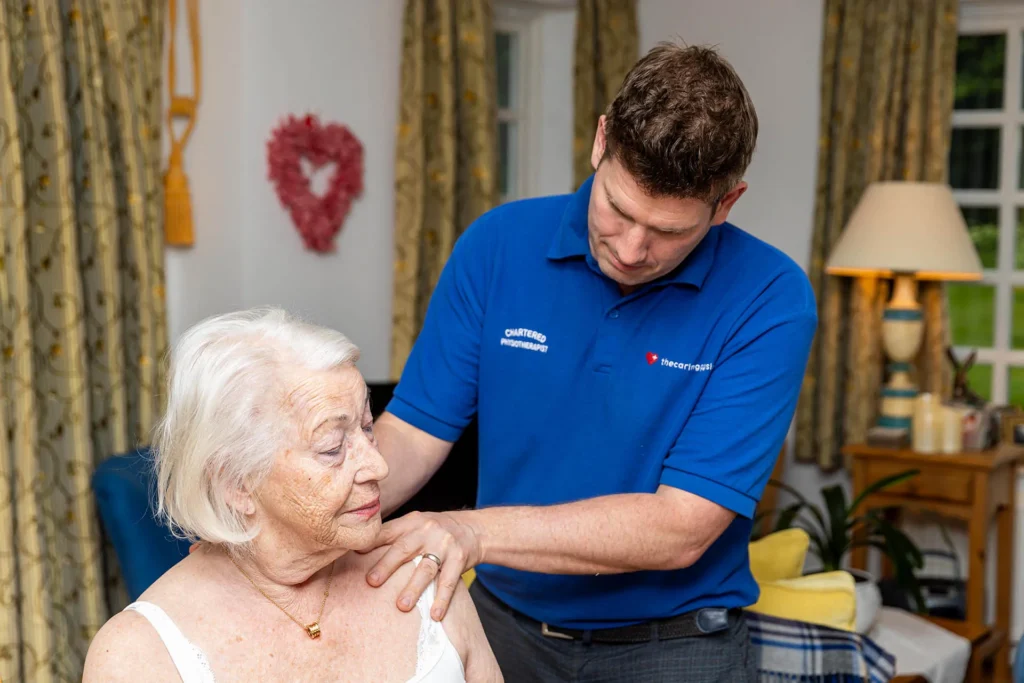
Your physiotherapist in Eastbourne
Bindu N. is a chartered physiotherapist based in Eastbourne, with more than 21 years’ experience across hospital, community and neurological rehabilitation in Sussex. She has worked as a Senior Community Physiotherapist with Sussex Community NHS Foundation Trust, helping people get home from hospital safely, and ran Otago strength and balance groups at Milton Grange, East Sussex County Council’s reablement unit. She previously led the therapy team at The Chaseley Trust.
Much of her work is with people after a stroke or a hospital stay, and with Parkinson’s, multiple sclerosis and brain injury. She will see you at home, plan the exercises around what you want to get back to, and keep your family in the loop.

What families say about Bindu
“She was brilliant with my husband and has given him back the confidence in himself that he lost while in hospital. I can’t recommend her more highly.”
Annette, Eastbourne · about Bindu, after her husband’s hospital stay
Safe to leave is not the same as back to yourself
Eastbourne District General has a frailty unit on Seaford Ward and a twenty-seven-bedded medical ward on Westham with an interest in frailty; stroke patients go to Sovereign, or through the hyper-acute beds on East Dean. By the time somebody is discharged they will usually have been got up, walked a few steps on a flat floor with staff either side, and judged safe to go. If the admission was a hip or a knee, the joint may have been done at the Horder Centre in Crowborough, which carries out more hip and knee replacements than any other independent hospital in the UK — but the surgery gives the joint back, and the walking, the stairs and the confidence come from what happens in the weeks afterwards.
The corridor is level, wide, and has a rail on both sides. Her hallway has a rug, a turn at the bottom of the stairs and nobody standing behind her. What the ward finished, somebody still has to carry on — and the first fortnight at home is when most of the ground is lost. This is the gap we close. Ring us with the discharge date and we will book the first visit around it.
“10 per cent of their muscle mass after just 10 days in a hospital bed”
East Sussex Healthcare — the trust that runs the DGH — puts it plainly in its own campaign against deconditioning: a person aged over eighty can lose ten per cent of their muscle mass after just ten days in a hospital bed. It is not the illness that does it. It is the sitting still. And it keeps happening at home afterwards, quietly, in a comfortable chair with everybody being kind. The answer is ordinary and well established: the UK Chief Medical Officers advise “activities aimed at improving or maintaining muscle strength, balance and flexibility on at least 2 days a week” for everyone over 65.
East Sussex Healthcare NHS Trust, campaign to end PJ paralysis · UK Chief Medical Officers’ Physical Activity Guidelines
“If it is always done for her, she will not get stronger.”
Not a criticism of anyone. It is quicker to do it for her, it is safer in the moment, and it feels kinder — any of us would. But every stand somebody else does is a stand she has not done. What we do is show whoever is there, family or carers, where the rehabilitation is hiding inside the day they already have.
How we close the gap
As soon as you have a date
Ring us with the discharge date and we book the first visit around it.
Worked at the level that helps
Hard enough to make a difference, not so hard it sets you back. Getting that judgement right is most of the job.
The right exercises, done with you
Not a sheet of diagrams left on the table. We do them with you, correct them as you go, and change them as you improve.
As far as the bandstand
Flat, sheltered, and close enough to be realistic. For a lot of people here it is the walk worth getting back, and it makes a better goal than anything we could set in a front room.
The things people actually want back
Nobody rings us asking for a stronger quadriceps. They ring because something ordinary has stopped being possible, and it is the ordinary things that decide whether a week is worth having. These are the goals we hear most often in Eastbourne, and they are the ones we measure against.
- Getting out of your own chair without a hand under your arm.
- The stairs, without planning them the night before.
- Getting to the front door before whoever is knocking gives up.
- Standing long enough to make a proper cup of tea.
- Getting in and out of a car — so the appointment, the funeral and the grandson’s wedding stay possible.
- A night without working out how you will manage the bathroom.
None of these is a small thing. Each one is a piece of somebody’s independence, and each one is specific enough to work towards and to measure. We write down where you are at the first visit, so progress later is a fact rather than an impression.
Areas we cover in and around Eastbourne
Eastbourne itself
- Meads
- Old Town
- Upperton
- Ratton
- Hampden Park
- Langney
- Roselands
Willingdon and the northern edge
- Willingdon
- Lower Willingdon
- Wannock
- Polegate
- Stone Cross
- Shinewater
The coast and the Downs villages
- Sovereign Harbour
- Pevensey Bay
- Westham
- East Dean
- Friston
- Jevington
- Alfriston
- Seaford
That covers most of BN20, BN21, BN22, BN23, BN24 and BN26. If your road is not on the list, ring us anyway — the boundary is about how far a physiotherapist can sensibly travel in a day, not a line on a map.
Helping you recover using physiotherapy in the comfort of your home
FAQ - Your local questions
Can you help my mother get home from the Eastbourne DGH?
Yes, and the best time to ring is before she comes home rather than after. We take referrals straight from families — no GP letter, no waiting list. If she has been on Seaford, the frailty unit, or on Westham, she will have been got up and walking on a flat ward floor with staff either side. Her own hallway, her own stairs and her own bathroom are a different proposition, and the first fortnight home is when most of the ground is lost. Tell us the discharge date when you have it and we will get the first visit into that week.
She has stopped walking along the seafront. Nothing has happened. Is that worth a call?
It is the call we most wish families made sooner. Nothing dramatic has to happen for someone to lose a great deal of strength — they simply stop doing the walk they always did, and then the legs follow the habit down over a few months. By the time there is a fall there is usually a year of quiet decline behind it, and that decline is the part that responds best to work. We would aim at the actual walk: the front steps, the promenade, the bench she used to head for, and back. Not exercises on a mat.
Do you come out to the villages, or only into Eastbourne itself?
We come to you, wherever you are. Meads, Old Town, Willingdon, Hampden Park, Langney and Polegate, and out to Pevensey Bay, East Dean, Jevington, Friston and Alfriston. There is no clinic to get to and no car park to negotiate, which for a lot of our clients is the whole point — the journey to an appointment is often harder than the appointment.
My father’s flat is on the second floor and the lift is small. Does that matter?
It matters, and mostly in a useful way. A great many Eastbourne flats are conversions with a lift that takes one person and a frame at a push, and a flight of stairs as the only alternative. We would far rather see that layout than hear about it, because it makes the goal specific: manage those stairs when the lift is out, get in and out of that lift with the frame, cross that lobby. A clinic gym cannot rehearse any of it.
My husband was told after his stroke that this is as good as it gets. Is it worth trying anything?
It is worth looking, and we will tell you honestly what we find. A prognosis is a judgement about how things stood on the day it was made, usually by somebody who was right about that day. Time is the commonest reason a goal gets missed — not enough of it to build the strength and the confidence that sit underneath the goal. The longer he has not done something, the bigger it looks, and that is normal rather than evidence. We would start by working out what is actually stopping him, which is more often confidence, or pain nobody has got on top of, than the stroke itself.
Do I need to ask her GP first?
No. We are chartered physiotherapists and you can ring us directly. With her permission we will write to her GP if we find something that needs a doctor — pain that is not controlled, a medication that is affecting her balance, something we are not happy about — and we are glad to report progress if the practice wants it. But nothing has to be arranged through the surgery before we can start.
How long would this go on for? I do not want an open-ended commitment.
Nor do we. We measure at the first visit, agree what we are actually aiming at, and tell you honestly whether we are getting there. Most people need a concentrated run of visits and then far less — a review every few weeks, or nothing at all. If we do not think we are adding anything, we will say so. We would rather tell you that than keep coming. Our fees are published in full on the pricing page.
Local support in Eastbourne
As well as physiotherapy, families often need to know what else is out there. These are the local organisations we are asked about most, and none of them charges for advice.
Health and Social Care Connect — East Sussex County Council’s first point of contact for adult social care, open twenty-four hours a day including bank holidays, on 0345 60 80 191. This is where a care assessment starts.
Age UK East Sussex — free, local and confidential information and advice, along with the Isabel Blackman Centre and the Charles Hunt Centre for people who would be better for some company as well as some exercise.
Care for the Carers — the carers’ centre for East Sussex, based on Faraday Close in Eastbourne, with a Carers Hub on 01323 738390. Around one person in ten in East Sussex is looking after somebody, and a great many of them have never called themselves a carer.
East Sussex Healthcare’s carer support — for families whose relative is on a ward at the DGH and who need to know what happens next.
Care homes in Eastbourne
Most of this work is arranged and paid for privately by families — a block of visits after a fall or a hospital stay, or ongoing work to keep someone moving. It sits alongside whatever the home already provides, and we work with their staff so the exercises carry on between our visits. You can read more about additional physiotherapy for residents.
Care home managers in Eastbourne — get in touch to discuss regular visiting physiotherapy for your residents.
Eastbourne is one of our East Sussex areas, alongside home visit physiotherapy in Brighton. If you are looking after someone further along the coast or inland towards the Downs, see all the areas we cover — and if the town you need is not listed, ring us anyway and we will tell you honestly whether we can reach you.