
Home Visit Physiotherapy in Clevedon
Get in touch today
If you have any questions or to see how we can help
Physiotherapy at home in Clevedon and the surrounding villages
We provide home-visit physiotherapy across Clevedon and the villages around it.
Clevedon is a town of just over twenty-one thousand people, and North Somerset Council’s own placemaking work says plainly that more of them are over sixty-five than the North Somerset average — in a county where nearly one resident in four already is. So a great many families here are having the same conversation at once. Some ring us with a relative on the Elton Rehabilitation Unit at the community hospital on Old Street, waiting on a date. Just as many get in touch long before a hospital is involved: Mum on Dial Hill has given up the walk down to Hill Road, or Dad in Yeo Moor has begun resting on every landing. Those are early signs, and early is when help does most good. Being lifted from a seat you once left unaided is hard to accept, and no easier for a son or daughter to see.
Our services in Clevedon include:
- Older people’s physiotherapy — strength and balance for the kerbs, the steps and the slope, before a wobble becomes a fall.
- Dementia physiotherapy — keeping the walk to the table and the stand from the chair going for as long as they can.
- Post-operative rehabilitation — following hip or knee surgery at Southmead or the Bristol Royal Infirmary, or a spell on the Elton unit in the town.
- Neurological physiotherapy — for stroke, Parkinson’s and MS, built around your own daily tasks.
- Respiratory physiotherapy — for COPD and breathlessness, building up so the front and the hill stop being off limits.
- Muscle and joint pain — arthritis, sore backs, and joints left stiff by a fracture or a long lay-off.
- Care home physiotherapy — visits to residents in Clevedon and nearby homes, working with the staff who are there every day.
- Rehabilitation for case management clients — complicated recoveries from injury or surgery, with regular written updates for the case manager.
Why families in Clevedon come to us
Nearly one person in four across North Somerset is over sixty-five — 23.9% at the last census, against 18.6% across England and Wales — and the median age here is forty-five where England’s is forty. More than a quarter of adults are retired. Clevedon sits above even that average. It is a town built for walking, with the seafront, Poets Walk and Salthouse Fields at one end and Hill Road up at the other, and the difference between managing that and not managing it is the difference between a full life and a small one.
- Chartered physiotherapists, HCPC registered and CSP members, insured for work in homes and care homes.
- No waiting list of our own. If you are already waiting for NHS physiotherapy, we can start in the meantime and work alongside it.
- Every visit is a full hour, and the plan moves at your pace.
- We enjoy this work. Seeing someone walk back along the front under their own steam is why we do it.
- The reasons behind each exercise are explained to relatives too, not only to the person doing it.
- We do not give up on people because of their age. We look at what is stopping them and say honestly what can change.
The first visit is a full assessment and it includes treatment. You fill in a form beforehand, so we do not spend the hour asking about tablets and operations. We look at how you get about your own home and work out what is stopping you doing the thing you most want back, whether that is strength, pain, balance or nerve after a fall. Then we start on it the same day. We also agree who else can help between visits, a husband, a daughter or the carers, because one visit a week works best when the days in between are used too.
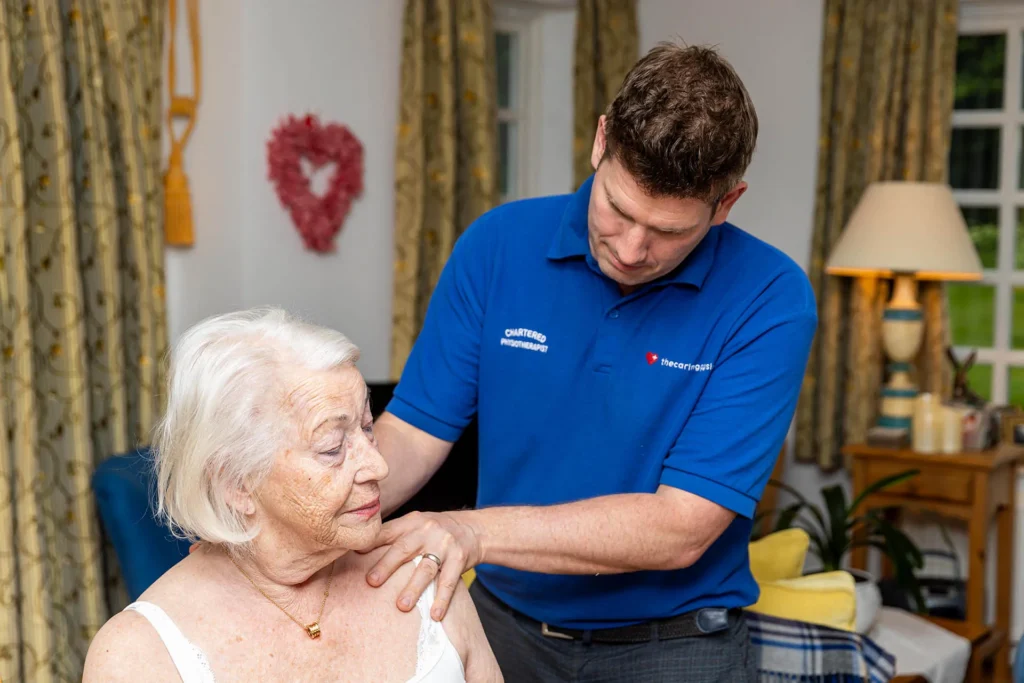
NHS rehabilitation stops when the goals stop. Life does not.
Clevedon is better served than most towns its size. The Elton Rehabilitation Unit sits on the first floor of North Somerset Community Hospital on Old Street — Sirona describe it as an inpatient service for “rehabilitation and recovery”, with a physiotherapist and an occupational therapist on the team and support to relearn things like cooking and washing. The minor injury unit downstairs is open eight until eight, seven days a week. For anything acute it is Southmead or the Bristol Royal Infirmary, both now part of Bristol NHS Foundation Trust.
But every one of those services is time-limited and goal-limited by design. Sirona’s own stroke team says it plainly: they continue until “you do not have any more therapy goals”. That is the right way to run a public service, and it is not the same as being back to yourself. That is where we come in. Let us know when she is due home and we will plan the first visit for that week.
“Just 10 days of bed rest in hospital can mean muscles ageing by an equivalent of 10 years in patients over 80”
That is Whittington Health NHS Trust, explaining why its wards encourage patients to get up and get dressed. Muscle goes quickly once somebody stops using it, and inactivity is what does it, which continues after discharge in a favourite chair, surrounded by kindness. The better news comes from the British Geriatrics Society: “Deconditioning is not an inevitable consequence of ageing – it is preventable and reversible.”
Whittington Health NHS Trust, April 2018 · British Geriatrics Society, Deconditioning Hub
Care that can step down
As strength comes back, the care around someone can often step down: one carer where there were two, or one visit fewer in the day. We work with the family and the carers so that the help being given builds independence back.
How we close the gap
Help when it is needed
The first days home matter most. Tell us what is happening and we will fit the first visit in as early as we can.
Worked at the level that helps
Enough effort to count, never so much that the next day is lost. Judging that well is a large part of what you are paying for.
For as long as it helps
Visits continue for as long as they are changing something, and we tell you when that is no longer true. Strength is the aim, and a measure of dignity returns with it.
As far as Poets Walk
The loop out past the headland and home by the seafront is level and mostly out of the wind. Plenty of people in Clevedon name it as the walk they most want again.
What Clevedon families tell us they miss
People do not ring us about muscles. They ring because an ordinary part of the day has become a struggle, and the list below is what families in Clevedon tell us they miss most.
- Getting up from your chair by yourself.
- Walking from room to room without reaching for the furniture.
- Getting dressed sitting on the edge of your own bed, without help with the buttons.
- Hanging out the washing or watering the pots by the back door.
- Round the headland and along the front, with a sit on a bench because you want one.
- Walking down your road to see a neighbour, without the fear of your legs failing you.
We note where you are starting from on the first visit and come back to it, so you can see the change for yourself.
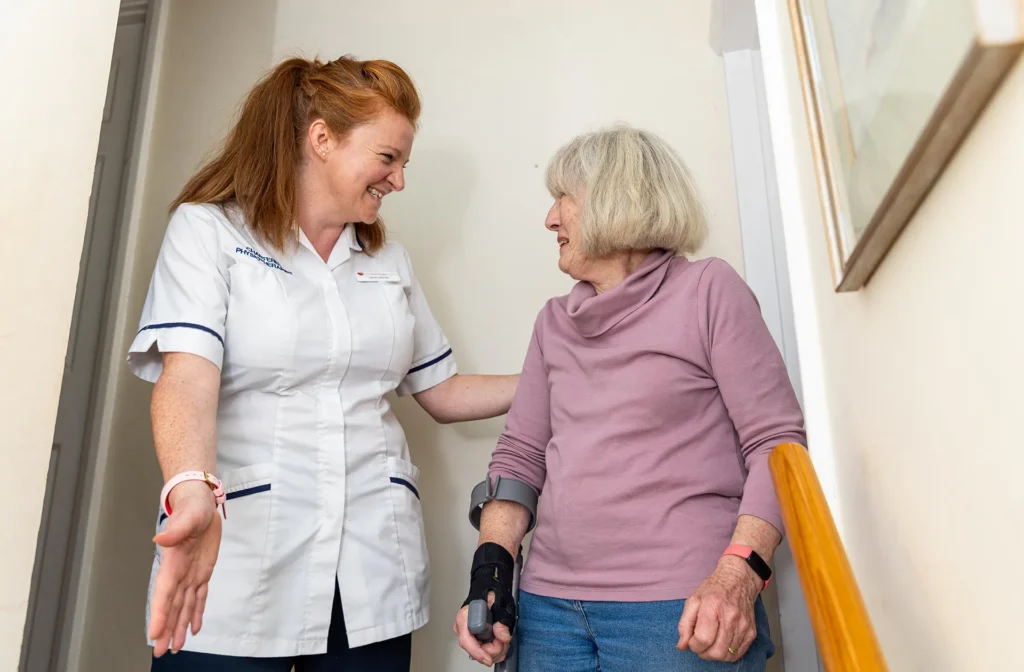
Clevedon and the places around it that we visit
Clevedon itself
- Clevedon town centre
- East Clevedon
- Yeo Moor
- Dial Hill
- Hill Road
- Old Church Road
- Walton
The seafront and the hills
- Marine Parade
- Salthouse Fields
- Wains Hill
- Strawberry Hill
- Poets Walk
- Conygar
The villages around
- Tickenham
- Kenn
- Kingston Seymour
- Walton-in-Gordano
- Weston-in-Gordano
- Clapton-in-Gordano
- Yatton
- Nailsea
That takes in most of BS21 and the villages either side. If you are not sure whether we reach you, ring and ask; we would rather say yes or no on the phone than leave you guessing.
Helping you recover using physiotherapy in the comfort of your home
FAQ - Your local questions
Mum is finishing her stay on the Elton unit. Can you pick things up when she is home?
Yes, and it is worth ringing before she is discharged rather than after. A rehabilitation unit works to goals set on the ward, and when those goals are met the admission ends — which is the right way to run a unit, and also why people so often arrive home still some distance from managing it. What the unit cannot rehearse is her own hallway, her own stairs and the slope up to her front door. We take referrals straight from families, with no GP letter needed, and the first visit is usually within a few days of her getting home.
My wife no longer goes down to the seafront, though she has had no fall. Should I ring you?
We would always sooner hear at this stage. Strength can drain away with no single event to blame: one regular walk is dropped and, a few months on, the legs are no longer up to it. Most falls have a long, unnoticed slide behind them, and that slide is the part physiotherapy can do most about. Our plan would follow the walk itself, from her front step to Marine Parade and the bench she liked, then home again. No mats and no gym.
We live out at Kenn. Do you travel that far from Clevedon?
All our sessions take place where you live. We cover East Clevedon, Yeo Moor, Dial Hill, Walton and the seafront, and travel on to Tickenham, Kenn, Kingston Seymour, the Gordano villages, Yatton and Nailsea. You will not need to arrange transport or find a parking space, and for a good many of our clients that removes the hardest part of the whole business.
The NHS team discharged him and he is nowhere near back to normal. Is that usual?
It is usual, and it is not a criticism of anybody. Sirona’s own stroke team describes the rule plainly: they continue until “you do not have any more therapy goals”, or those goals can be worked towards without the team. That is the right way to run a public service with a waiting list behind it. It is simply not the same as being back to yourself. Most of our work starts exactly at that point, and we are happy to pick up where they left off rather than start again.
What happens if my father simply refuses on the day you come?
Then we do not push, and the visit is not wasted. Most refusals are about that particular day: a bad night, pain, or not wanting to be shown up in front of family. We sit down, talk, and find out which it is, and quite often something small follows from that — standing up to look at the garden, a walk to the door to see us out. If it is a firm no, we respect it and let you know. Over time people usually come to trust that we will not make them do anything, and that is when the real work starts. We would rather go slowly than lose him at the first visit.
My father has been told he is too frail for rehabilitation. Is it worth us asking again?
It deserves a second look, and you will get a straight account of what we see. An opinion of that kind describes one moment, and the person who gave it was probably right about that moment. Goals are most often missed for lack of time to build strength and nerve, not because they were impossible. Something left untried for months grows in the mind, which is ordinary and proves nothing. Our first job would be to find out what is really holding him back.
Is there a set number of visits, or does it just carry on?
Nor should it. At the first visit we agree a specific target and write down the starting point, so progress is something you can see rather than something you have to take on trust. Most people have a concentrated run of visits while the work is producing change, then much less — a review now and then, or nothing at all. We will tell you when we think that point has come, and we would rather have that conversation early than keep arriving out of habit. Our fees are set out in full on our FAQ page.
Local support in Clevedon
Physiotherapy is rarely the only help a family needs. These local organisations give free advice and are the ones people ask us about.
North Somerset Council adult social care — the starting point for a care assessment. After a hospital stay its reablement service can provide as much as six weeks of help at no cost.
Age UK Somerset — a free source of guidance for older residents and relatives.
Carers Support Bristol and South Gloucestershire — help for unpaid carers; ring 0117 965 2200.
Care homes in Clevedon
Care homes in Clevedon include Avery Healthcare’s Poets Mews on Cherry Avenue, alongside a number of smaller independent homes. Physiotherapy in a care home is normally arranged and paid for by the family, alongside whatever the home provides. We fit round meals and care routines, tell the family how each visit went, and show the care team how to keep the practice going. You can read more about physiotherapy for care home residents.
Care home managers in Clevedon — get in touch to discuss regular visiting physiotherapy for your residents.
Clevedon is one of our North Somerset areas, a short drive from home visit physiotherapy in Bristol. If the town you need is not listed, see all the areas we cover — or ring us anyway and we will tell you honestly whether we can reach you.