
Home Visit Physiotherapy in Gloucester
Get in touch today
If you have any questions or to see how we can help
Compassionate physiotherapy delivered at home in Gloucester
At The Caring Physio, we provide home visit physiotherapy across Gloucester, shaped around your goals and daily life. Our clinicians visit you where you live—your own home or a care home—so effective treatment happens without the disruption of getting to a clinic. Every member of our Gloucester team is HCPC-registered and a CSP member, with deep experience in care for older adults, recovery after surgery, and management of long-term conditions—delivered with compassion, integrity, and enjoyment. We work to rebuild strength, steadiness, and independence after illness, operations, or falls. At your first visit, we take a full history and evaluate movement, balance and strength to design a focused rehabilitation programme.
Our services in Gloucester include:
- Physiotherapy for older adults to boost balance, mobility, and confidence.
- Structured post-operative rehabilitation following discharge from hospital.
- Neurological physiotherapy for conditions such as stroke, Parkinson’s, and MS.
- Respiratory physiotherapy to improve breathing efficiency and stamina.
- Targeted treatment for muscle and joint pain.
- Specialist physiotherapy for care home residents.
- Case-managed rehabilitation programmes tailored to individual needs.
Why families in Gloucester come to us
Gloucester brings together cathedral grandeur, revitalised docks, and the Gloucester & Sharpness Canal—perfect settings for staying active close to home. From riverside and towpath walks to match-day climbs around Kingsholm, we help you move comfortably in the places you love. We deliver home visits throughout Gloucester and nearby communities, including Staunton, Bromsberrow, Ledbury, Ross-on-Wye, Quedgeley, Longlevens, Hucclecote, Churchdown, Brockworth, Maisemore, and Innsworth.
Why people in Gloucester choose us:
- Experienced physiotherapists focused on effective, home-visit care.
- Flexible appointment options, with times that fit your routine.
- Professional treatment in your home or care home—no clinic journeys required.
- Joined-up support with GPs, consultants, and care teams.
- A warm, values-led approach grounded in compassion, integrity, and enjoyment.
Every course of care begins with a thorough assessment to plan the right therapy for you. Book your home physiotherapy visit in Gloucester or the surrounding area today, and start your recovery in the comfort of home.
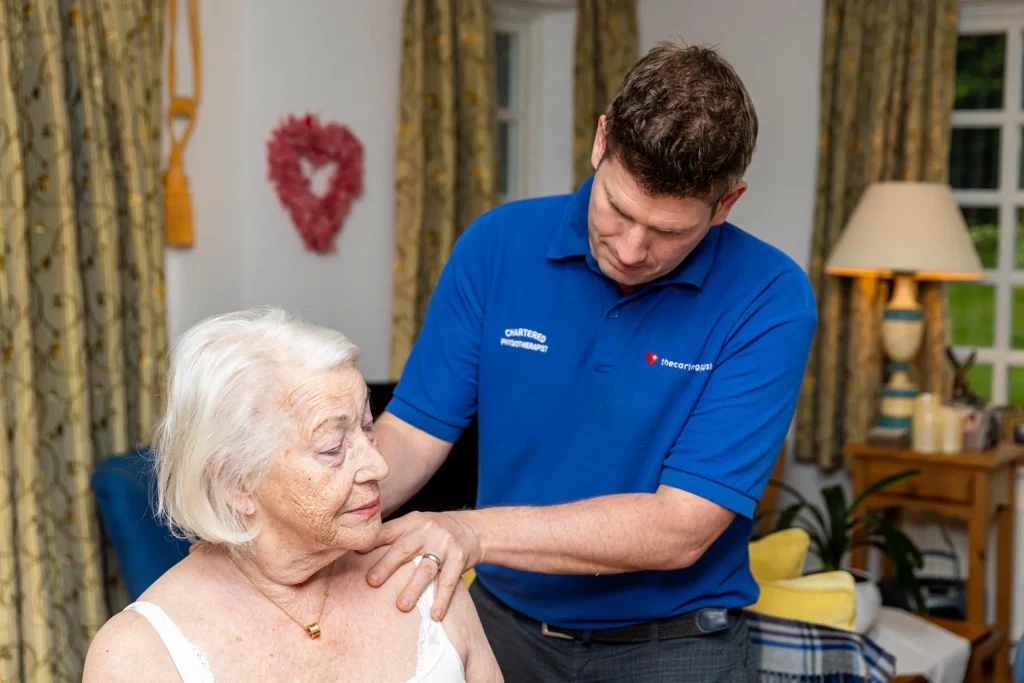


Helping you recover using physiotherapy in the comfort of your home
FAQ - Your local questions
Can you help my mother come home from Gloucestershire Royal?
Yes, and it is worth ringing before she leaves rather than after. We take referrals straight from families, so nothing has to go through the ward. If she has been through the Frailty Assessment Unit or one of the Gallery wards, she will have had good work done on getting up and moving a few steps — the gap is almost always between that and managing her own hallway, her own stairs and her own bathroom. Tell us the discharge date when you have it and we will book the first visit into that first week home, which is when confidence slips fastest.
My mum has started sleeping downstairs. Nothing has happened, but it worries me. Is that a reason to ring?
It is a very good reason, and it is one of the clearest signals there is. Moving the bed down is almost never about preference — it is usually the stairs becoming a job rather than a habit, and once the upstairs is given up, the walking that kept her strong goes with it. Nothing needs to have gone wrong for this to be worth an hour of assessment. Stairs respond well to focused work, and it is far easier to get them back within months than years. The best time to ring is before the fall, not after it.
My father had a hip replacement on Ward 3A and his NHS physiotherapy has finished. Can you carry on from there?
Yes, and it is one of the commonest reasons people come to us. NHS post-operative physiotherapy is good and it is also finite — it takes someone to a safe, sensible standard and then stops, often while there is still real progress available. Picking it up at home means working on the things a clinic cannot rehearse: his own stairs in Longlevens or Hucclecote, the step down to the garden, the walk back from the car. We would ask what the hospital team were working towards, carry it on rather than start again, and build from where they left him.
My mother is forgetful. How will you get her to do the exercises?
Mostly by not relying on her to remember them. A sheet of instructions on the kitchen table is no use to somebody whose short-term memory has gone, and it is not how we work. We practise real movements in the real place — standing from her own chair, walking her own landing — because the body holds onto far more than the mind can recall on demand. We repeat, we demonstrate rather than explain, and we build the work into things that already happen every day so nothing depends on her remembering a programme.
My father is deaf and gets frustrated when people talk over him. How would you manage that?
By slowing down and making sure he is actually in the conversation rather than being discussed. It sounds small and it is not: a great deal of what goes wrong in rehabilitation for older people comes from decisions being made over their heads by well-meaning families and professionals. We face him, we make sure he can see us, we check he has understood rather than assuming, and we ask him what he wants to work on rather than agreeing it with you first. He stays the person we are working with, not the subject of the visit.
We are starting to talk about a care home. Would physiotherapy make any difference to that decision?
Sometimes it changes the decision and sometimes it confirms it, and either is useful. What tips most families towards a home is not one big thing — it is transfers becoming a two-person job, the bathroom becoming unmanageable, or the fear of another fall. Some of that is fixable with focused work, and some of it genuinely is not. We would assess honestly and tell you which, including if our view is that the time has come. Knowing you looked properly is worth having, whichever way it goes, and it is not a conversation we will dress up.
She has just come home and I am frightened she will fall the first night. What can we do straight away?
Ring us and we will get to you quickly, and in the meantime there are a few things worth doing before dark. Clear the route she will actually walk at night — bed to bathroom — and leave a light on it. Put what she needs within reach on the side she gets out of, not the side that looks tidy. And sit with her while she does that walk once, so you both know what it looks like. When we come we work on that route specifically, because getting up in the dark is where a large share of falls at home happen.
Local support in Gloucester
As well as physiotherapy, families often need to know what else is out there. These are the organisations we are asked about most, and none of them charges for advice.
Gloucestershire County Council adult social care — where an assessment of care needs starts.
Age UK Gloucestershire — free local information and advice, on 01452 422660.
Gloucestershire Carers Hub — for anyone looking after somebody, on 0300 111 9000.
Care homes in Gloucester
Most of this work is arranged and paid for privately by families — a block of visits after a fall or a hospital stay, or ongoing work to keep someone moving. It sits alongside whatever the home already provides, and we work with their staff so the exercises carry on between our visits. You can read more about additional physiotherapy for residents.
Care home managers in Gloucester — get in touch to discuss regular visiting physiotherapy for your residents.